Searching for an Australian Shepherd puppy for sale can be exciting. Those fluffy faces, striking merle coats, bright eyes, and playful personalities make Aussie puppies hard to resist. But choosing the right puppy involves much more than finding the cutest photo or the lowest price.
The Australian Shepherd is an intelligent, athletic, and highly energetic herding breed. These dogs were developed for work, and many retain a strong instinct to move, control, and watch livestock. Their intelligence can make them wonderfully trainable, but it also means they need regular mental stimulation and meaningful activities.
Before buying an Aussie puppy, prospective owners should consider health testing, temperament, socialization, breeder practices, exercise requirements, and long-term costs. A responsible breeder should care about where each puppy goes just as much as the buyer cares about finding the right puppy.
The American Kennel Club describes Australian Shepherds as smart, work-oriented, energetic dogs with a strong herding impulse. Their activity level can be challenging for sedentary households, but it can be an excellent match for active owners who enjoy training, hiking, running, dog sports, or outdoor activities.
There is also an important distinction between buying an Australian Shepherd from a responsible breeder and simply purchasing a puppy from an online seller. A responsible breeder considers health, structure, temperament, genetics, and appropriate placement. They should also be willing to answer questions and provide documentation.
Adoption is another option worth considering. Some Australian Shepherds and Aussie mixes need homes through breed-specific rescues, shelters, or private rehoming organizations. Whether you adopt or purchase from a breeder, the goal should be the same: finding a healthy dog whose personality and needs fit your lifestyle.
This guide will walk you through the process—from understanding the breed and finding reputable Australian Shepherd puppies for sale to evaluating health records, choosing a puppy, preparing your home, and raising a confident companion.
Quick Facts About Australian Shepherd Puppies
| Trait | Australian Shepherd Puppy |
|---|---|
| Breed Name | Australian Shepherd |
| Common Name | Aussie |
| Origin | United States |
| Breed Group | Herding |
| Adult Size | Medium |
| Adult Height | About 18–23 inches |
| Adult Weight | Varies by sex and build |
| Lifespan | About 12–15 years |
| Coat | Medium-length double coat |
| Energy Level | High |
| Intelligence | Very high |
| Temperament | Intelligent, energetic, loyal, work-oriented |
| Grooming | Moderate |
| Exercise Needs | High |
| Training | Highly trainable |
| Best For | Active families, working owners, experienced dog owners |
The Australian Shepherd is a medium-sized herding dog known for intelligence, athleticism, and a strong desire to participate in activities with its people. Adult Aussies generally stand around 18–23 inches tall, while typical adult weight varies according to sex, structure, and individual build.
What Is an Australian Shepherd?
Australian Shepherd Breed Overview
The Australian Shepherd, often called an Aussie, is a medium-sized herding breed recognized for its intelligence, agility, endurance, and devotion to its owners.
Despite its name, the breed was developed primarily in the United States, where it became closely associated with ranching and livestock work. Australian Shepherds were valued for their ability to work independently while remaining responsive to their handlers.
Today, Aussies can be found in many roles. Some still work livestock, while others compete in agility, obedience, rally, herding, dock diving, and other dog sports. Many are simply energetic family companions.
The important thing to remember is that the modern family Aussie still carries much of the working-dog mentality that helped create the breed.
Is the Australian Shepherd Really From Australia?
No. Despite its name, the Australian Shepherd did not originate in Australia.
The breed’s history is connected to American ranching and herding. The name became associated with the dogs partly because of their perceived connection with sheep and livestock imported through Australia and the broader influence of dogs associated with that trade.
The Australian Shepherd eventually became strongly associated with American ranches and the Western lifestyle.
Australian Shepherd History and Origin
Australian Shepherd history is somewhat complex because the breed developed from several working-dog influences rather than from one clearly documented foundation breed.
Dogs with British and European herding ancestry contributed to the development of American livestock-working dogs. Over generations, American ranchers selected dogs for practical characteristics such as intelligence, endurance, agility, responsiveness, and herding ability.
The breed became especially popular among ranchers, farmers, and horsemen in the American West.
Today, that working heritage is still visible in the Aussie’s behavior. Even a puppy raised purely as a companion may instinctively try to control movement, chase fast-moving objects, or follow people around the home.
What Was the Australian Shepherd Bred For?
The Australian Shepherd was developed primarily as a working and herding dog.
Its job required more than simply chasing livestock. A useful ranch dog needed to listen to its handler, make quick decisions, cover considerable ground, and remain focused despite distractions.
That combination helped create a breed with exceptional working intelligence.
When searching for an Australian Shepherd puppy for sale, buyers should therefore ask themselves an important question:
Can I provide the kind of active lifestyle this breed was designed for?
If the answer is yes, an Aussie can be an incredibly rewarding companion. If not, some of the breed’s greatest strengths can become challenges.
Australian Shepherd Herding Instinct
Australian Shepherd puppies may begin displaying herding behaviors at a surprisingly young age.
A puppy may:
- Follow family members from room to room
- Chase running children
- Circle other dogs
- Stare intensely at moving objects
- Attempt to control the movement of pets
- Nip at heels during excitement
- Chase bicycles or joggers
These behaviors do not automatically indicate aggression. They are often expressions of the breed’s natural working instincts.
Early training can teach an Aussie when these instincts are appropriate and when they need to settle down.
Australian Shepherd Intelligence
Australian Shepherds are exceptionally intelligent. They often learn new behaviors quickly and can remember routines, patterns, and environmental cues.
The downside is that an intelligent puppy can also learn bad habits quickly.
For example, if an Aussie discovers that barking gets attention, jumping gets rewarded, or chasing the family cat produces an exciting game, the puppy may repeat the behavior.
This is why early training matters.
Short, positive training sessions can help channel the puppy’s intelligence into useful behaviors instead of allowing boredom to turn into destructive habits.
Australian Shepherd Working Ability
Aussies excel when they have something meaningful to do.
Their working ability can be expressed through:
- Herding
- Obedience
- Agility
- Rally
- Tracking
- Scent work
- Trick training
- Hiking
- Fetch
- Farm work
- Other dog sports
AKC breed guidance emphasizes that Australian Shepherds need both physical activity and mental stimulation.
Australian Shepherd as a Family Companion
An Australian Shepherd can be an excellent family dog when its needs are properly met.
A well-socialized Aussie can form a close bond with its family and enjoy participating in everyday activities. However, this is not typically a breed that is happiest being ignored in the backyard all day.
Aussies often want to be involved.
They may follow their owners around the house, watch what everyone is doing, and become restless when there is nothing interesting to occupy their minds.
Australian Shepherd vs Miniature American Shepherd
The Miniature American Shepherd is a separate recognized breed, although it shares ancestry and many characteristics with the Australian Shepherd.
Both breeds are intelligent herding dogs with high activity levels, but they differ in size and breed history.
If an advertisement says “Mini Australian Shepherd,” buyers should ask exactly what the seller means. The term can be used informally, while Miniature American Shepherd is the recognized breed name.
Australian Shepherd Puppy for Sale: What Should You Look For?
What Does “Australian Shepherd Puppy for Sale” Mean?
An advertisement for an Australian Shepherd puppy for sale tells you almost nothing about the quality of the breeding by itself.
A puppy may be advertised as:
- AKC registered
- Champion-bred
- Blue merle
- Red merle
- Working-line
- Farm-raised
- Health tested
- Family raised
- Ready to go home
Those descriptions can be useful, but they should always be verified.
A beautiful advertisement is not proof of a responsible breeder.
The best puppy-buying decisions come from looking behind the advertisement.
Where Can You Find Australian Shepherd Puppies for Sale?
Potential buyers can find Aussie puppies through several channels:
- Breed-club breeder directories
- Reputable breeder websites
- AKC Marketplace listings
- Local dog clubs
- Australian Shepherd events and shows
- Breed-specific rescue organizations
- Personal recommendations from Australian Shepherd owners
How to Find Australian Shepherd Puppies From Responsible Breeders
Finding a responsible breeder usually takes patience.
Instead of asking only, “Do you have puppies available?”, ask questions about:
- Health testing
- Parent dogs
- Temperament
- Puppy socialization
- Veterinary care
- Registration
- Contracts
- Return policies
- Previous litters
- Breeding goals
A responsible breeder should also want to know about you.
They may ask about your home, work schedule, previous dog experience, activity level, children, other pets, and plans for training.
That isn’t unnecessary interference. It can be a sign that the breeder genuinely cares about puppy placement.
Australian Shepherd Breeder Directories
Breed-club directories can be useful for finding breeders who are actively involved in the Australian Shepherd community.
However, directory membership alone should not replace your own research.
Always verify:
- Health records
- Breeding practices
- Living conditions
- Contract terms
- Puppy socialization
- Parent temperament
AKC Australian Shepherd Puppy Listings
The AKC Marketplace can be another useful place to begin researching breeders.
The AKC also has programs such as Bred with H.E.A.R.T., which emphasize health, education, accountability, responsibility, and tradition in breeding practices.
Still, buyers should conduct their own due diligence rather than assuming that a listing automatically guarantees a perfect puppy.
ASCA Australian Shepherd Breeders
The Australian Shepherd Club of America (ASCA) is an important breed-specific resource for people researching Australian Shepherds.
Breed organizations can help buyers learn about breed standards, health concerns, responsible breeding, and the qualities that make an Australian Shepherd suitable for different homes.
Local Australian Shepherd Breeders
A local breeder can be especially convenient because you may be able to visit the property before making a decision.
An in-person visit can help you observe:
- The mother
- The puppies
- The living environment
- Cleanliness
- Socialization
- General puppy behavior
- How the breeder interacts with the dogs
A breeder who refuses reasonable opportunities to verify these things deserves additional scrutiny.
Australian Shepherd Rescue Puppies
Buying from a breeder isn’t the only way to bring an Aussie home.
Australian Shepherd rescues sometimes have puppies, adolescents, adults, or senior dogs looking for homes.
An older Australian Shepherd may actually be a better match for some families because its personality and energy level are easier to evaluate.
Online Australian Shepherd Puppy Listings
Online listings can be convenient, but they also require caution.
Don’t let an attractive puppy photograph make the decision for you.
Ask for current photos or videos, verify the breeder’s identity, request health documentation, and look for evidence that the puppy actually exists in the advertised environment.
Should You Buy an Australian Shepherd Puppy Online?
You can research breeders online, but purchasing a puppy should involve more than clicking a “buy now” button.
Whenever practical, meet the breeder and puppy in person. If distance makes that impossible, request a live video interaction and independently verify the seller’s information.
Be particularly cautious when a seller:
- Refuses video calls
- Won’t show the mother
- Wants immediate payment
- Uses only stock-looking photographs
- Claims multiple unrelated breeds are always available
- Adds unexplained transportation charges
- Pressures you to make a decision immediately
Why You Should Visit the Breeder Before Buying
Visiting the breeder gives you information that photographs cannot provide.
You can observe whether puppies appear alert, curious, clean, and appropriately socialized. You can also see how the adult dogs behave.
ASCA’s breeder guidance emphasizes responsible placement and keeping puppies with the litter until at least eight weeks of age.
A breeder should be comfortable discussing how the puppies are raised and prepared for life with their future families.
How to Find a Responsible Australian Shepherd Breeder
What Makes an Australian Shepherd Breeder Responsible?
A responsible Australian Shepherd breeder is not simply someone who owns a female dog and has puppies available.
Good breeders typically plan litters carefully and consider:
- Health
- Genetics
- Temperament
- Structure
- Working ability
- Breed characteristics
- Future puppy placement
The AKC similarly emphasizes that responsible breeders should understand breed health and genetics and make thoughtful breeding decisions.
How Long Has the Breeder Been Breeding Aussies?
Experience can be helpful, but the number of years breeding dogs should not be your only criterion.
A newer breeder who works with knowledgeable mentors and follows appropriate health-testing practices may be more responsible than someone who has bred dogs for decades without proper screening.
Ask what the breeder has learned about the breed and why they selected the particular parents.
Does the Breeder Health-Test the Parents?
This is one of the most important questions you can ask.
Health testing helps identify certain inherited or structural risks before dogs are used for breeding.
For Australian Shepherds, AKC currently lists recommended testing that includes:
- Hip evaluation
- Elbow evaluation
- Ophthalmologist evaluation
- MDR1 DNA testing
- Hereditary cataract testing
- PRA-prcd DNA testing
Can the Breeder Show Health Certificates?
Don’t settle for statements such as “The parents are healthy.”
Ask to see actual documentation.
Depending on the test, records may come from organizations such as OFA or from recognized veterinary laboratories.
A trustworthy breeder should be able to explain what was tested, why it was tested, and how the results influenced their breeding decisions.
Does the Breeder Let You Meet the Mother?
Meeting the puppy’s mother can provide useful information about adult temperament, structure, and general health.
The father’s information is also important, although the sire may not live at the breeder’s property.
Can You Meet the Australian Shepherd Puppies?
Ideally, you should be able to observe the litter before making your final decision.
Look for puppies that are:
- Alert
- Curious
- Clean
- Responsive
- Comfortable interacting with people
- Appropriately active for their age
Avoid choosing solely on appearance.
Does the Breeder Ask Questions About Your Home?
A responsible breeder may ask questions such as:
- Have you owned an Aussie before?
- How active is your household?
- Do you have children?
- Do you have other pets?
- How much time will the puppy spend alone?
- What training plans do you have?
- Are you interested in herding or dog sports?
These questions help match the right puppy with the right home.
Does the Breeder Offer a Health Guarantee?
A written health guarantee can provide useful protection, but read the details carefully.
Look for information about:
- What conditions are covered
- How long coverage lasts
- Required veterinary examinations
- Buyer responsibilities
- What happens if a serious inherited condition is discovered
Does the Breeder Provide a Written Contract?
A puppy sales contract should clearly explain the responsibilities of both parties.
It may include information about:
- Registration
- Health guarantees
- Spay/neuter requirements
- Breeding rights
- Return policies
- Veterinary care
- Buyer responsibilities
Never sign a contract you don’t understand.
Does the Breeder Offer Lifetime Support?
Responsible breeders often remain a resource after the puppy leaves.
That support can be especially valuable with an intelligent, active breed such as the Australian Shepherd.
Does the Breeder Have a Puppy Return Policy?
Ask what happens if your circumstances change and you can no longer care for the dog.
A breeder who is committed to the puppies they produce should have a clear plan for responsible rehoming or return.
Why Responsible Breeders May Have Waiting Lists
A waiting list is not automatically a bad thing.
In fact, it can be a positive sign when a breeder produces relatively few carefully planned litters.
A breeder who always has dozens of puppies available in multiple breeds deserves more scrutiny than someone who plans occasional litters and carefully interviews buyers.
Why a Responsible Breeder May Not Always Have Puppies Available
Quality breeding is not a production-line business.
A breeder may wait for:
- Appropriate health clearances
- The right breeding combination
- Mature breeding dogs
- Suitable homes
- Appropriate timing
So if you find a breeder you trust but they don’t have an Australian Shepherd puppy available immediately, waiting may be safer than rushing into a questionable purchase.
Australian Shepherd Puppy Health Testing
Why Health Testing Matters When Buying an Aussie Puppy
Australian Shepherds are generally considered a healthy breed, but no breed is free from inherited health risks.
Health testing cannot guarantee that a puppy will never become sick. Instead, it gives breeders valuable information that can help them make more responsible breeding decisions.
Australian Shepherd Genetic Health Testing
Genetic testing can identify whether a dog carries certain inherited variants.
For Australian Shepherds, recognized testing considerations include conditions involving MDR1, hereditary cataracts, and progressive retinal atrophy, among others.
Hip Testing
Hip evaluations help assess the condition of the hip joints and identify dogs with hip dysplasia or related structural concerns.
Ask the breeder for documentation rather than relying on a verbal assurance.
Elbow Testing
Elbow evaluation is another recommended screening area for Australian Shepherd breeding dogs.
Healthy joints are particularly important for a breed expected to run, jump, work, and remain physically active throughout life.
Eye Examinations
Eye examinations can help identify ocular problems that may affect Australian Shepherds.
A breeder should be able to explain when the parents were examined and provide appropriate documentation.
Genetic Testing for Australian Shepherds
DNA testing can be extremely useful, but it should be viewed as one component of a broader health program.
A DNA panel cannot replace physical examinations, orthopedic evaluations, eye examinations, good husbandry, and thoughtful breeding decisions.
Australian Shepherd Cataract Risk
Hereditary cataracts are among the health concerns associated with Australian Shepherds.
The AKC includes HSF4 hereditary cataract testing among its current breed-specific health-testing recommendations.
Australian Shepherd Epilepsy
Epilepsy is another health concern buyers may hear about when researching the breed.
Ask breeders whether epilepsy has occurred in their lines and how they approach family health history.
Australian Shepherd MDR1 Considerations
MDR1, or multidrug sensitivity, is particularly important because certain genetic variants can affect how a dog responds to some medications.
The AKC includes MDR1 DNA testing among the recommended health tests for Australian Shepherds.
This is useful information to have not only when choosing a puppy but also when communicating with your veterinarian throughout the dog’s life.
What Health Clearances Should Australian Shepherd Parents Have?
At minimum, buyers should ask about the breed’s recommended orthopedic, eye, and genetic screening.
The current AKC breed-health recommendations include hip and elbow evaluations, ophthalmologist evaluation, MDR1, hereditary cataract, and PRA-prcd testing.
How to Verify a Breeder’s Health Testing
Ask the breeder for documentation and, where applicable, verify results through recognized databases.
Don’t accept a screenshot with no identifying information or a simple statement such as “all health tested.”
Why DNA Testing Alone Is Not Enough
A puppy can come from DNA-tested parents and still face health problems.
Responsible breeding requires a broader approach that considers:
- Genetics
- Physical structure
- Eyes
- Joints
- Temperament
- Family history
- Environment
- Nutrition
- Veterinary care
What Health Records Should Come With a Puppy?
Before taking your Australian Shepherd puppy home, ask for a complete puppy record that may include:
- Vaccination history
- Deworming history
- Veterinary examination
- Microchip information
- Registration paperwork
- Pedigree
- Health guarantee
- Feeding instructions
- Medication information, if applicable
- Parent health-testing documentation
Keep these records in a safe place and provide copies to your veterinarian.
The goal isn’t simply to buy an Australian Shepherd puppy. The goal is to bring home a puppy with the best available foundation for a long, healthy, well-adjusted life.
How Much Does an Australian Shepherd Puppy Cost?
The price of an Australian Shepherd puppy can vary considerably depending on location, breeder reputation, pedigree, health testing, bloodlines, registration, and whether the puppy is intended primarily as a companion, show prospect, or working dog.
A low price isn’t necessarily a bargain, and a high price doesn’t automatically mean a better puppy.
The most important question is what you are getting for the price.
Australian Shepherd Puppy Price
In the United States, a responsibly bred Australian Shepherd puppy commonly costs around $800 to $2,500 or more, although prices can fall outside this range depending on the breeder and bloodline.
Factors that can influence price include:
- Health testing of both parents
- Pedigree and bloodline
- Breeder experience
- Geographic location
- Puppy socialization
- Veterinary care
- Registration
- Working or show potential
- Demand
- Breeder reputation
Prices also change over time, so buyers should research several comparable breeders rather than relying on one advertised figure.
Average Australian Shepherd Puppy Cost
When comparing an Australian Shepherd puppy for sale, don’t compare prices without comparing what is included.
One puppy might cost less but receive minimal veterinary care. Another might cost more because the breeder has invested heavily in health screening, veterinary examinations, early socialization, registration, and quality nutrition.
A useful comparison looks like this:
| Cost Factor | Why It Matters |
|---|---|
| Parent health testing | Helps identify inherited risks |
| Veterinary examination | Checks puppy health before placement |
| Vaccinations | Establishes early preventive care |
| Deworming | Helps address common intestinal parasites |
| Microchip | Provides permanent identification |
| Registration | Documents breed registration where applicable |
| Pedigree | Shows ancestry |
| Socialization | Helps puppies develop confidence |
| Contract | Defines buyer and breeder responsibilities |
| Health guarantee | Establishes specific contractual protections |
Why Australian Shepherd Puppies Have Different Prices
Two Aussie puppies can look almost identical but have very different backgrounds.
A responsible breeder may spend significant amounts on health testing, veterinary care, training, nutrition, facilities, and raising puppies properly.
That investment can be reflected in the purchase price.
Pet-Quality vs Show-Quality Australian Shepherd Puppies
The terms pet quality and show quality generally refer to how closely a puppy conforms to the breed standard and whether its structure and other characteristics make it suitable for exhibition.
A pet-quality puppy can still make an outstanding companion.
For most families, temperament, health, and lifestyle compatibility matter much more than whether a puppy has potential for the show ring.
Working-Line Australian Shepherd Puppy Prices
Working-line Aussies may be bred specifically for livestock work, performance, or other demanding activities.
These puppies can have particularly strong:
- Work drive
- Herding instinct
- Athletic ability
- Focus
- Endurance
A working-line puppy can be an excellent choice for a farmer or experienced dog-sport enthusiast, but it may be more demanding for an average household.
Registered vs Unregistered Australian Shepherd Puppies
Registration can provide useful pedigree information, but registration alone does not guarantee health or quality.
Ask what organization provides the registration and what the registration actually means.
Buyers should never assume that registration eliminates the need to investigate the breeder.
Does Australian Shepherd Color Affect Price?
It can.
Some buyers specifically search for blue merle Australian Shepherd puppies or red merle puppies, which can increase demand.
However, coat color should never be more important than:
- Health
- Temperament
- Genetic screening
- Breeder quality
- Lifestyle compatibility
A healthy black or red Aussie from an excellent breeder is a much better choice than an unhealthy puppy with a fashionable coat.
Does Merle Color Cost More?
Some sellers charge more for merle puppies because buyers perceive them as more unusual or desirable.
That doesn’t mean a merle puppy is inherently healthier, smarter, or better.
Never pay a premium simply because a puppy has a particular color.
Why You Should Be Careful With Extremely Cheap Puppies
An unusually cheap Australian Shepherd puppy deserves careful investigation.
A low price may sometimes reflect:
- Lack of health testing
- Poor breeding practices
- Minimal veterinary care
- Poor socialization
- Inadequate living conditions
- Misrepresented pedigree
- A scam
Not every inexpensive puppy is problematic, but buyers should ask why the price is substantially below comparable puppies.
Why Extremely Expensive Puppies Are Not Always Better
The opposite is also true.
A breeder charging several thousand dollars isn’t automatically producing superior puppies.
A high price should be supported by meaningful differences in:
- Health testing
- Breeding quality
- Veterinary care
- Puppy development
- Socialization
- Pedigree
- Breeder support
What Is Included in the Puppy Price?
Before paying a deposit, ask the breeder for a written list of everything included.
It may include:
- Initial vaccinations
- Deworming
- Microchipping
- Veterinary examination
- Registration paperwork
- Pedigree
- Puppy food
- Toys
- Health records
- Health guarantee
- Contract
- Lifetime breeder support
Deposit Fees
Some breeders require a deposit to reserve a puppy.
Before sending money, make sure you understand whether the deposit is:
- Refundable
- Non-refundable
- Transferable to another litter
- Applied to the final purchase price
Never send money simply because a seller says another buyer is waiting.
Shipping Costs
Shipping a puppy can add significant expense.
Whenever possible, personally collecting the puppy is preferable because it allows you to meet the breeder and reduces some transportation complications.
If transportation is necessary, carefully verify the carrier and all fees.
Transportation Costs
Long-distance puppy purchases can involve:
- Ground transportation
- Air transportation
- Travel crates
- Veterinary certificates
- Health examinations
- Airport fees
- Travel expenses
Get the complete cost in writing before making a commitment.
Initial Veterinary Costs
The purchase price is only the beginning.
You should budget for:
- Veterinary examinations
- Vaccinations
- Parasite prevention
- Microchip registration
- Flea and tick prevention
- Heartworm prevention where appropriate
- Emergency care
- Training
Lifetime Cost of Owning an Australian Shepherd
An Aussie can live for many years, so think beyond the puppy price.
Over its lifetime, you may spend money on:
- Food
- Veterinary care
- Preventive medications
- Training
- Grooming supplies
- Toys
- Boarding
- Pet insurance
- Emergency treatment
- Equipment
Buying the puppy is a one-time expense. Caring for the dog is a long-term commitment.
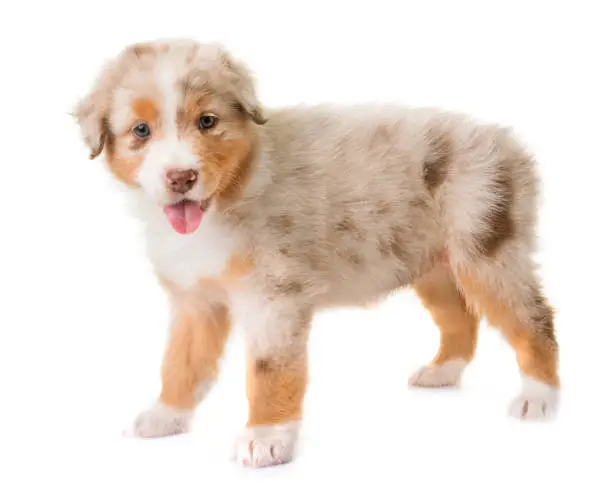
Australian Shepherd Puppy Colors
One of the biggest attractions of the breed is its beautiful range of coat colors and patterns.
Blue Merle Australian Shepherd Puppy
The blue merle Australian Shepherd puppy has a mottled pattern containing black patches against a gray or blue-gray background.
Many blue merles also have:
- White markings
- Copper/tan points
- Different combinations of facial markings
Blue merle is visually distinctive, but buyers should remember that appearance says little about the quality of breeding.
Red Merle Australian Shepherd Puppy
Red merle Aussies have a mottled pattern based on red or liver coloring.
They can have white and copper markings, creating a highly recognizable Australian Shepherd appearance.
Black Australian Shepherd Puppy
Black is one of the traditional Australian Shepherd colors.
A black Aussie may be solid black or have white and/or copper markings depending on its genetic combination.
Red Australian Shepherd Puppy
Red Australian Shepherds range from lighter reddish shades to deeper liver-like tones.
They may also have white and copper markings.
Black Tri Australian Shepherd Puppy
A black tri Australian Shepherd generally combines:
- Black base color
- White markings
- Copper/tan points
The result is one of the classic Aussie appearances.
Red Tri Australian Shepherd Puppy
A red tri Australian Shepherd combines:
- Red base color
- White markings
- Copper/tan points
This is another popular traditional color pattern.
Blue Merle Tri Australian Shepherd
A blue merle tri typically combines the mottled blue-merle base with white and copper markings.
The exact appearance varies considerably from puppy to puppy.
Red Merle Tri Australian Shepherd
A red merle tri has the red-merle pattern combined with white and copper markings.
White Australian Shepherd Puppies
A predominantly white Australian Shepherd puppy requires special attention.
Excessive white coloring can be associated with genetic concerns, particularly when merle genetics are involved.
Buyers should never assume that an unusually white puppy is simply a rare or desirable color.
Australian Shepherd Color Genetics
Australian Shepherd coat color is influenced by multiple genes.
This means puppies from the same litter can have very different appearances.
Responsible breeders understand these genetics and plan pairings carefully.
Why Merle-to-Merle Breeding Is a Major Concern
One of the most important genetic issues buyers should understand is merle-to-merle breeding.
When two merle dogs are bred, some puppies can inherit two copies of the merle variant. These puppies are often called double merles.
Double-merle puppies have an increased risk of serious vision and hearing abnormalities.
For this reason, buyers should ask breeders specifically about the parents’ coat genetics.
Double Merle Australian Shepherd Puppies
Double-merle puppies can have large areas of white coat and may have:
- Hearing impairment
- Vision abnormalities
- Eye defects
- Other developmental concerns
This is why responsible breeders carefully consider merle genetics rather than breeding simply for attractive coat patterns.
Australian Shepherd Eye and Hearing Concerns Related to Merle Genetics
Merle genetics can affect pigmentation in tissues involved in hearing and vision.
The important lesson for buyers is simple:
Never choose an Australian Shepherd puppy solely because its unusual color looks rare.
Health and responsible breeding should come first.
Should You Choose an Aussie Puppy Based on Color?
No.
Color can be part of your preference, but it should come after:
- Health
- Temperament
- Genetic testing
- Parent quality
- Socialization
- Breeder practices
- Lifestyle fit
A good breeder should help you choose a puppy based on its overall suitability rather than simply handing you the puppy with the most fashionable markings.
Australian Shepherd Puppy Size and Growth
How Big Does an Australian Shepherd Get?
Australian Shepherds are medium-sized dogs.
According to the AKC breed standard, males generally stand around 20–23 inches, while females generally stand around 18–21 inches.
Adult weight can vary significantly depending on sex, genetics, body structure, and conditioning.
Australian Shepherd Puppy Growth Stages
Aussie puppies go through several developmental stages.
A simplified progression looks like:
| Age | Typical Development |
| 8 weeks | Beginning life with new family |
| 10–12 weeks | Rapid learning and socialization |
| 3–4 months | Increasing coordination and curiosity |
| 5–6 months | Stronger body and emerging adolescence |
| 7–12 months | Adolescent behavior and continued growth |
| 12+ months | Approaching adult physical maturity |
| 18–24 months | Continued mental and physical maturity |
Individual puppies develop at different rates.
Australian Shepherd Puppy Weight by Age
There is no single weight that every Aussie puppy should reach at a particular age.
Growth depends on:
- Genetics
- Sex
- Nutrition
- Activity
- Overall health
- Adult size of parents
A veterinarian is better positioned to determine whether an individual puppy is growing appropriately.
Australian Shepherd Puppy Height by Age
Height also varies considerably.
Instead of comparing your puppy with an internet growth chart, focus on consistent development and healthy body condition.
Male vs Female Australian Shepherd Size
Males are generally larger than females, although there is overlap.
A smaller male can weigh less than a larger female.
When Does an Australian Shepherd Stop Growing?
Most Aussies reach much of their adult height during the first year, but they may continue filling out and developing muscle beyond that point.
Mental maturity can take longer than physical growth.
Australian Shepherd Adult Size
An adult Australian Shepherd is athletic rather than bulky.
The breed’s body is designed for movement, endurance, agility, and working efficiency.
Australian Shepherd Puppy Growth Chart
Online growth charts can be useful as rough references, but they should not be treated as medical standards.
A puppy’s growth should be evaluated based on its individual genetics and physical condition.
Factors That Affect Puppy Growth
Important factors include:
- Genetics
- Nutrition
- Parasites
- Illness
- Exercise
- Sleep
- Overall veterinary care
If you notice sudden weight loss, poor growth, persistent diarrhea, lethargy, or other concerning symptoms, contact your veterinarian.
How to Tell If an Aussie Puppy Is Growing Normally
A healthy puppy should generally show:
- Gradual growth
- Good appetite
- Appropriate energy
- Healthy stool
- Shiny coat
- Good muscle development
- Normal behavior
Your veterinarian can monitor weight and development during puppy visits.
Australian Shepherd Puppy Temperament
What Is an Australian Shepherd Puppy Like?
Aussie puppies are often bright, curious, energetic, playful, and highly responsive.
They can also be intense.
A puppy may quickly learn household routines and become extremely attached to its family.
That intelligence is wonderful, but it requires guidance.
Are Australian Shepherd Puppies Affectionate?
Many Australian Shepherds form strong bonds with their owners.
They may enjoy:
- Following family members
- Playing games
- Training
- Cuddling after activity
- Participating in outdoor adventures
However, individual temperament varies.
Are Australian Shepherd Puppies Intelligent?
Yes.
Australian Shepherd puppies can learn commands, routines, tricks, and problem-solving tasks quickly.
This makes early training especially rewarding.
Are Australian Shepherd Puppies Energetic?
Absolutely.
Even a young puppy needs appropriate outlets for its energy.
However, puppy exercise should be carefully controlled. A growing puppy shouldn’t be treated like a miniature adult athlete.
Are Australian Shepherd Puppies Easy to Train?
They are often highly trainable, but easy to train does not mean easy to own.
Aussies can understand what you want quickly, but they may also become bored with repetitive training.
Use short sessions and vary activities.
Are Australian Shepherd Puppies Protective?
Some Aussies are naturally watchful and alert.
However, protective behavior should not be deliberately encouraged in a puppy.
Instead, focus on calmness, socialization, confidence, and appropriate responses to unfamiliar people.
Do Australian Shepherd Puppies Bark a Lot?
Some do.
Barking can occur because of:
- Excitement
- Alertness
- Frustration
- Boredom
- Herding behavior
- Environmental stimulation
Early training can teach the puppy when quiet behavior is expected.
Do Australian Shepherd Puppies Herd People?
They can.
A puppy may chase or nip at moving feet, particularly when children are running.
This should be redirected calmly rather than punished harshly.
Why Do Aussie Puppies Chase Children?
Running children can trigger an Aussie puppy’s herding instincts.
The puppy may interpret rapid movement as something that needs to be controlled.
Supervision is essential, particularly with young children.
Are Australian Shepherd Puppies Good With Children?
They can be excellent family companions when appropriately socialized and supervised.
However, parents should understand that herding instinct and puppy behavior can create challenges.
Children should be taught not to:
- Chase the puppy
- Roughhouse
- Pull ears or tails
- Take food away
- Disturb the puppy while sleeping
Are Australian Shepherd Puppies Good With Other Dogs?
With appropriate socialization, many Aussies can live successfully with other dogs.
Early positive experiences can help puppies develop appropriate social skills.
Are Australian Shepherd Puppies Good With Cats?
Some can live successfully with cats, but individual prey drive and herding instinct matter.
Aussie puppies should be introduced gradually and supervised around cats.
Never assume that because a puppy is friendly with people, it will automatically be safe with every small animal.
Australian Shepherd Prey Drive
Prey drive can vary from one Aussie to another.
Some may chase:
- Cats
- Birds
- Squirrels
- Rabbits
- Bicycles
- Running objects
Good recall and impulse-control training are particularly valuable.
Australian Shepherd Independence
Although Aussies often bond closely with people, they are capable working dogs that can make decisions independently.
This combination of independence and intelligence can sometimes produce a dog that asks:
“Why should I do that?”
Training should make cooperation rewarding.
Australian Shepherd Sensitivity
Many Aussies are responsive to their owner’s voice and body language.
Harsh corrections can damage trust and may contribute to fear or avoidance.
Positive reinforcement and clear boundaries are generally more productive.
Australian Shepherd Separation Concerns
Because Aussies often form close bonds with their owners, they should be gradually taught to spend time alone.
Puppies need a predictable routine that includes:
- Rest periods
- Independent play
- Safe confinement
- Gradual alone-time practice
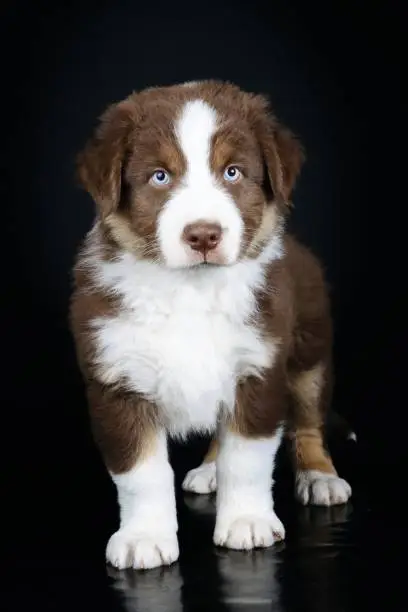
Are Australian Shepherd Puppies Good Family Dogs?
Australian Shepherd Puppies for Families
An Aussie can be a wonderful family dog, but the household must understand the breed.
The best match is generally a family that enjoys activity and is willing to provide consistent training.
Australian Shepherd Puppies for Active Families
Active households can be an excellent match.
An Aussie may enjoy joining family members for:
- Hiking
- Walking
- Running when mature
- Training
- Outdoor games
- Dog sports
Australian Shepherd Puppies for Children
Aussies can bond strongly with children, but supervision is important.
The combination of puppy teeth, high energy, and herding instinct can be difficult for very young children.
Australian Shepherd Puppies for First-Time Owners
A first-time owner can successfully raise an Aussie, but it requires preparation.
First-time owners should be ready to invest in:
- Puppy classes
- Socialization
- Daily training
- Exercise
- Mental stimulation
Australian Shepherd Puppies for Experienced Owners
Experienced owners may appreciate the breed’s responsiveness and versatility.
Someone familiar with working breeds may also be better prepared for behaviors such as chasing, herding, and intense engagement.
Australian Shepherd Puppies for Seniors
The breed’s activity level can make it challenging for some seniors.
An Aussie may work well for a particularly active older owner, but lifestyle should matter more than age.
Australian Shepherd Puppies for Rural Homes
Rural environments can provide excellent opportunities for activity, but simply having land isn’t enough.
Aussies still need:
- Human interaction
- Training
- Mental stimulation
- Supervision
- Secure fencing
Australian Shepherd Puppies for Apartment Living
An apartment does not automatically disqualify an Australian Shepherd.
However, apartment owners must be prepared to provide substantial daily activity outside the home.
A large backyard can also be useless if the dog spends most of its time there without interaction.
Australian Shepherd Puppies for Farms and Ranches
This can be one of the breed’s most natural environments.
Aussies can thrive when they have structured work, appropriate training, and safe access to livestock.
Who Should Not Buy an Australian Shepherd Puppy?
An Aussie may be a poor choice for someone who:
- Wants a low-energy dog
- Works long hours with no plan for the puppy
- Dislikes training
- Wants a dog that is content doing nothing
- Doesn’t enjoy outdoor activity
- Cannot provide mental stimulation
- Is unwilling to manage herding behaviors
Breed suitability matters more than how adorable the puppy looks in a photograph.
How to Choose the Right Australian Shepherd Puppy
Male vs Female Australian Shepherd Puppy
There can be physical and behavioral differences between individual males and females, but sex alone does not determine temperament.
A breeder who knows the litter may be better able to recommend an individual puppy.
Choosing an Aussie Puppy Based on Temperament
Temperament should be one of your biggest priorities.
Depending on your lifestyle, you might prefer a puppy that is:
- Confident
- Social
- Focused
- Curious
- Moderately energetic
- Comfortable being handled
Choosing a Puppy for a Family
Families may benefit from a puppy that is confident and socially comfortable without being excessively intense.
A breeder who observes the litter every day can often provide useful guidance.
Choosing a Puppy for Dog Sports
If you plan to compete in agility, obedience, rally, or another sport, tell the breeder.
They can help identify puppies with suitable drive and focus.
Choosing a Puppy for Herding
Working homes should discuss herding ability with the breeder.
A puppy intended for livestock work may have different characteristics from one selected primarily as a companion.
Choosing a Puppy for Companionship
For a family companion, prioritize:
- Stable temperament
- Good socialization
- Health
- Confidence
- Compatibility with your household
How Breeders Match Puppies With Families
Experienced breeders often watch puppies over several weeks.
They may observe:
- Confidence
- Play style
- Food motivation
- Response to handling
- Curiosity
- Recovery from new experiences
- Interaction with littermates
This information can be more useful than choosing the puppy with the prettiest face.
Puppy Temperament Testing
Formal puppy temperament tests can provide information, but they are not perfect predictors of adult behavior.
A puppy’s environment, training, socialization, genetics, and experiences after leaving the litter also matter.
Confident vs Shy Australian Shepherd Puppies
A confident puppy generally approaches new experiences with curiosity.
A shy puppy may need more careful socialization.
Neither should automatically be labeled “good” or “bad,” but buyers should choose a puppy whose temperament matches their experience and goals.
Signs of a Healthy Aussie Puppy
Look for a puppy that is:
- Bright and alert
- Curious
- Clean
- Active for its age
- Comfortable moving around
- Interested in food
- Free of obvious discharge
- Living in a clean environment
Signs of an Unhealthy Puppy
Potential warning signs include:
- Persistent coughing
- Difficulty breathing
- Severe lethargy
- Ongoing diarrhea
- Nasal discharge
- Eye discharge
- Extremely poor body condition
- Hair loss or significant skin problems
- Difficulty walking
One symptom doesn’t necessarily diagnose a disease, but concerning signs should prompt veterinary evaluation.
How Active Should an Australian Shepherd Puppy Be?
A puppy should have periods of play followed by plenty of sleep.
More exercise isn’t always better.
Growing puppies need appropriate activity without excessive repetitive impact.
Should You Pick the Puppy or Let the Breeder Choose?
For many buyers, allowing an experienced breeder to help choose the puppy can be beneficial.
You know your lifestyle.
The breeder knows the litter.
Combining both perspectives can produce a better match.
Australian Shepherd Puppy Health Checklist
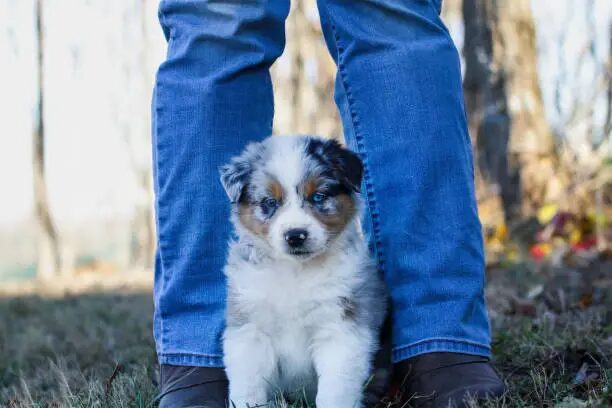
What Should a Healthy Australian Shepherd Puppy Look Like?
A healthy puppy should generally appear bright, appropriately active, and well cared for.
Don’t evaluate the puppy in isolation. Look at the entire litter and living environment.
Clear Eyes
Eyes should generally appear clear and comfortable without significant discharge, swelling, or obvious abnormalities.
Clean Ears
Ears should not have obvious foul odors, heavy debris, or significant discharge.
Healthy Skin and Coat
The coat should be reasonably clean and the skin should not show obvious severe irritation, sores, or widespread hair loss.
Normal Breathing
A puppy should breathe comfortably.
Persistent coughing, wheezing, labored breathing, or unusual respiratory sounds deserve veterinary attention.
Healthy Body Condition
A puppy should not appear severely underweight or excessively overweight.
Your veterinarian can provide a more accurate body-condition assessment.
Active and Curious Behavior
Young puppies naturally sleep a lot, but when awake they should generally show appropriate curiosity and interaction.
Clean Living Environment
The puppy’s surroundings should be:
- Clean
- Safe
- Appropriately spacious
- Well maintained
- Free from obvious excessive waste
Healthy Mother and Littermates
Look at the mother if possible.
Her health and temperament provide valuable information about the environment and breeding program.
Warning Signs of Illness
Don’t ignore:
- Persistent diarrhea
- Vomiting
- Coughing
- Nasal discharge
- Eye discharge
- Extreme lethargy
- Poor appetite
- Severe itching
- Difficulty breathing
When Should a Puppy See a Veterinarian?
A new puppy should have a veterinary examination according to your veterinarian’s recommended schedule.
If the puppy appears sick immediately after purchase, contact a veterinarian promptly.
Pre-Purchase Veterinary Examination
Depending on the breeder’s contract and circumstances, buyers may arrange an independent veterinary examination before the purchase is finalized.
This can provide additional peace of mind.
First Veterinary Visit After Bringing Your Puppy Home
Bring the puppy’s complete records to your veterinarian.
The visit can cover:
- Physical examination
- Vaccination planning
- Parasite prevention
- Nutrition
- Growth
- Dental development
- Microchip verification
- Breed-specific health considerations
- Future preventive care
Australian Shepherd Puppy Vaccinations and Veterinary Care
First Puppy Veterinary Examination
The first examination establishes a health baseline.
Your veterinarian can evaluate the puppy’s:
- Heart
- Lungs
- Eyes
- Ears
- Teeth
- Skin
- Abdomen
- Musculoskeletal system
- Body condition
Australian Shepherd Puppy Vaccination Schedule
Puppy vaccination schedules vary according to age, location, lifestyle, and veterinary recommendations.
Core vaccines are generally given through a series of puppy visits because young dogs require repeated protection as maternal antibodies decline.
Core Puppy Vaccines
Your veterinarian will determine which vaccines are appropriate.
Common core vaccination considerations include protection against serious diseases such as canine parvovirus, canine distemper, and adenovirus.
Deworming
Puppies commonly require parasite screening and/or deworming.
Follow your veterinarian’s recommendations rather than giving medications without professional guidance.
Flea and Tick Prevention
Aussies that spend time outdoors can be exposed to fleas and ticks.
Ask your veterinarian which prevention method is appropriate for your puppy’s age and weight.
Heartworm Prevention
Heartworm prevention may be important depending on your location and local parasite risk.
Your veterinarian can recommend an appropriate preventive program.
Microchipping
Microchipping provides permanent identification and is especially important if a puppy becomes lost.
Make sure the microchip is registered with your current contact information.
Puppy Dental Care
Begin introducing gentle dental care while the puppy is young.
Early handling can make future tooth brushing much easier.
Spaying and Neutering Considerations
The ideal timing for sterilization can depend on the dog’s sex, health, lifestyle, and veterinary advice.
There is no universal schedule that is perfect for every Australian Shepherd.
Australian Shepherd Puppy Health Records
Keep all records together, including:
- Vaccination dates
- Deworming
- Veterinary examinations
- Microchip information
- Registration
- Health testing documentation
- Medication records
Pet Insurance for an Australian Shepherd Puppy
Pet insurance can help manage unexpected veterinary expenses.
When comparing policies, pay attention to:
- Deductibles
- Reimbursement percentages
- Annual limits
- Waiting periods
- Hereditary-condition coverage
- Congenital-condition exclusions
- Pre-existing-condition rules
Don’t wait until a medical problem develops to investigate coverage, because many policies exclude conditions that existed before enrollment.
Australian Shepherd Puppy Training
When Should You Start Training an Aussie Puppy?
Training should begin as soon as the puppy comes home.
This doesn’t mean demanding long obedience sessions.
Start with simple behaviors such as:
- Responding to its name
- Looking at you
- Coming when called
- Sitting
- Settling
- Appropriate chewing
- Gentle handling
Australian Shepherd Puppy Socialization
Early socialization is one of the most important parts of raising an Aussie.
Expose your puppy gradually and positively to:
- People
- Sounds
- Surfaces
- Vehicles
- Household activities
- Grooming
- Veterinary handling
- Appropriate dogs
Positive Reinforcement Training
Reward behaviors you want to see repeated.
Rewards can include:
- Small treats
- Praise
- Toys
- Play
- Access to something the puppy enjoys
Name Training
Say your puppy’s name and reward it for looking toward you.
Repeat frequently in short sessions.
Recall Training
A reliable recall is especially valuable for an active breed.
Start indoors or in a secure environment before gradually increasing distractions.
Leash Training
Teach the puppy that walking beside you is rewarding.
Avoid turning every walk into a battle.
Crate Training
A crate should be a safe resting area rather than a punishment.
Introduce it gradually with meals, treats, toys, and calm periods.
House Training
Take the puppy out frequently, especially:
- After waking
- After eating
- After playing
- Before bedtime
Reward successful outdoor elimination immediately.
Bite Inhibition
Puppies naturally explore with their mouths.
Teach appropriate chewing and redirect biting toward suitable toys.
Teaching an Aussie Puppy Not to Herd People
If your puppy chases or nips at feet, avoid encouraging the game.
Instead:
- Stop the movement.
- Redirect attention.
- Ask for a simple behavior.
- Reward calmness.
- Provide an appropriate outlet for play.
Teaching Calm Behavior
One of the most valuable skills for an Aussie is learning that doing nothing is sometimes the correct job.
Reward your puppy for relaxing quietly.
Preventing Jumping
Reward four paws on the floor.
If jumping consistently produces attention, the puppy has little reason to stop.
Preventing Excessive Barking
Identify why the puppy is barking before trying to stop it.
Is it:
- Fear?
- Excitement?
- Boredom?
- Attention-seeking?
- Environmental alerting?
The solution depends on the cause.
Preventing Resource Guarding
Teach puppies that humans approaching food, toys, and resting areas can predict positive experiences.
Never deliberately provoke a puppy by repeatedly taking food away.
Training an Australian Shepherd Puppy to Focus
Focus exercises can be especially useful for this intelligent breed.
Reward your puppy for:
- Looking at you
- Following a hand target
- Responding to its name
- Walking beside you
- Ignoring distractions
Puppy Obedience Classes
A well-run puppy class can help with both training and socialization.
Look for instructors who use modern, humane training techniques.
Advanced Australian Shepherd Training
As your puppy matures, training can expand into:
- Advanced obedience
- Agility
- Rally
- Herding
- Scent work
- Trick training
- Competitive sports
An Aussie often thrives when learning never completely stops.
Australian Shepherd Puppy Exercise Needs
How Much Exercise Does an Australian Shepherd Puppy Need?
Puppy exercise should be age-appropriate rather than exhausting.
Young puppies need short periods of play and exploration followed by substantial rest.
Don’t attempt to satisfy an energetic breed by forcing a young puppy into long-distance running.
Puppy Exercise vs Adult Exercise
An adult Australian Shepherd may be capable of demanding physical activities that are inappropriate for a growing puppy.
As the dog matures, activity can gradually increase.
Why Too Much Exercise Can Be Harmful to Puppies
Repetitive high-impact activity can place unnecessary stress on developing joints and bones.
Avoid excessive:
- Long-distance running
- Repetitive jumping
- Forced jogging
- Extended stair climbing
- High-impact endurance sessions
Mental Stimulation for Aussie Puppies
Mental work can tire a puppy without requiring excessive physical exertion.
Try:
- Short training sessions
- Food puzzles
- Scent games
- Simple tricks
- Name games
- Find-it games
Puppy Play
Free play on safe surfaces allows puppies to move naturally while developing coordination.
Short Training Sessions
Several short sessions are often more effective than one long lesson.
Puzzle Toys
Food puzzles can provide useful mental enrichment.
Start with simple designs and supervise your puppy.
Scent Games
Hide treats in safe locations and encourage your puppy to find them.
This helps develop natural scenting behavior while providing mental stimulation.
Fetch for Australian Shepherd Puppies
Gentle fetch can be enjoyable, but avoid excessive repetitive throwing, especially while the puppy is young.
Safe Outdoor Activities
Appropriate outdoor activities may include:
- Gentle walks
- Sniffing
- Exploring secure areas
- Basic training
- Controlled play
When Can an Australian Shepherd Puppy Start Running?
Formal running should wait until the dog is physically mature enough for the activity.
Ask your veterinarian when your individual Aussie is ready for structured running.
When Can an Aussie Puppy Go Hiking?
Short, easy outings may be introduced gradually, but long hikes should wait until the puppy is physically mature.
Puppies need frequent breaks and should not be pushed beyond their developmental limits.
Dog Sports for Australian Shepherds
As an Aussie matures, it may excel in:
- Agility
- Obedience
- Rally
- Herding
- Disc sports
- Scent work
- Dock diving
Signs an Aussie Puppy Is Over-Tired
Watch for:
- Excessive biting
- Irritability
- Loss of focus
- Wild running
- Repeated falling asleep during activity
- Difficulty settling
Sometimes a “hyper” puppy isn’t under-exercised—it may simply be over-tired.
Signs an Australian Shepherd Puppy Is Bored
Boredom may appear as:
- Destructive chewing
- Excessive barking
- Digging
- Attention-seeking
- Repetitive behaviors
- Constant pestering
The answer isn’t always more physical exercise.
Often, the better solution is a combination of training, enrichment, structured play, and rest.
Australian Shepherd Puppy for Sale by Location
When searching for an Australian Shepherd puppy for sale, location can influence availability, transportation, pricing, and breeder options. However, buyers should avoid choosing a puppy simply because it is nearby.
A reputable breeder who prioritizes health and temperament may be a better choice than a questionable seller located only a few miles away.
Australian Shepherd Puppies for Sale in the USA
The United States is home to a large Australian Shepherd community, with breeders, working-dog programs, dog-sport kennels, and rescue organizations in many states.
When searching for an Aussie puppy in the USA, look for breeders affiliated with established breed organizations and verify health-testing information independently.
Useful searches include:
- Australian Shepherd puppies for sale USA
- Australian Shepherd breeders near me
- AKC Australian Shepherd puppies
- Australian Shepherd puppies from health-tested parents
- Australian Shepherd rescue puppies
Australian Shepherd Puppies for Sale in Texas
Texas has a strong working-dog and ranching culture, making Australian Shepherds a natural fit for many rural households.
However, a Texas breeder should still meet the same standards as breeders elsewhere. Ask about health testing, socialization, veterinary care, contracts, and parent dogs before placing a deposit.
Australian Shepherd Puppies for Sale in California
California buyers may find companion, show, and performance-line Australian Shepherds. Because online listings can make almost any puppy appear local, confirm the actual location of the breeder before sending money.
A video call can help initially, but an in-person visit is preferable whenever practical.
Australian Shepherd Puppies for Sale in Florida
Florida buyers should pay particular attention to how puppies are raised in warm weather. Ask how the breeder manages exercise, housing, ventilation, parasite prevention, and outdoor exposure.
Australian Shepherd Puppies for Sale in New York
When looking for an Australian Shepherd puppy in New York, consider both local breeders and reputable breeders in nearby states. Expanding your search radius can give you access to healthier, better-matched litters.
Australian Shepherd Puppies for Sale Near Me
Searching for an Australian Shepherd puppy near me can be convenient, but proximity should never replace careful research.
Before choosing a local seller:
- Verify the breeder’s identity.
- Visit the property if possible.
- Meet the mother.
- Ask about the father.
- Review health-testing records.
- Examine veterinary records.
- Observe how puppies interact with people.
- Read the contract before paying.
- Confirm the puppy’s age.
- Avoid pressure to make an immediate decision.
Australian Shepherd Puppy Price by Location
Australian Shepherd puppy prices can vary substantially depending on location and breeder practices.
Factors include:
- Local demand
- Cost of veterinary care
- Breeder experience
- Bloodline
- Working or performance potential
- Health testing
- Registration
- Puppy socialization
- Veterinary services included
- Transportation requirements
Rather than searching for the cheapest Australian Shepherd puppy, compare what is included in the purchase price.
| Cost Factor | Why It Matters |
|---|---|
| Health testing | Helps identify inherited risks in breeding dogs |
| Veterinary examination | Confirms the puppy has received professional care |
| Vaccinations | Reduces the risk of preventable disease |
| Deworming | Important for young puppies |
| Microchip | Provides permanent identification |
| Registration | Documents ancestry or breed registration |
| Socialization | Helps prepare puppies for family life |
| Contract | Defines responsibilities for buyer and breeder |
| Health guarantee | Provides additional buyer protection |
Australian Shepherd Puppy Price in the United States
Prices can differ considerably between breeders and regions. A puppy from extensively health-tested parents and an experienced breeder may cost more than one from an unknown seller.
The higher initial price does not automatically guarantee a better puppy, but extremely low prices can be a warning sign when combined with poor breeding practices or missing health records.
Australian Shepherd Puppy Price in Canada
Canadian buyers should consider the same factors as American buyers, along with transportation and border requirements when purchasing from another country.
Australian Shepherd Puppy Price in Australia
Despite the breed’s name, Australian Shepherds were developed in the United States. Buyers in Australia should therefore make sure they are dealing with breeders of Australian Shepherds, rather than assuming the breed originated locally.
Australian Shepherd Puppy Price in the UK
UK buyers should investigate breeder registration, health screening, puppy-rearing practices, and local legal requirements.
Australian Shepherd Puppy Price in Europe
European puppy prices can vary according to country, pedigree, registration, working ability, and breeder reputation.
Why Puppy Prices Differ by Location
Location affects costs, but breeder quality matters more than geography.
A responsible breeder typically invests in:
- Health testing
- Quality nutrition
- Veterinary care
- Appropriate housing
- Puppy socialization
- Training foundations
- Registration
- Responsible breeding practices
Transportation and Shipping Costs
Never assume that transportation is included in the advertised puppy price.
Ask for a complete written breakdown of:
- Puppy price
- Deposit
- Transportation
- Health certificate
- Crate
- Airline or ground transport fees
- Vaccinations
- Import documentation
- Other required expenses
Be particularly cautious if a seller repeatedly demands new payments for supposed shipping insurance, special crates, customs fees, or emergency transportation charges.
Australian Shepherd Puppy for Sale vs Adoption
Buying from a responsible breeder isn’t the only way to bring an Australian Shepherd into your home. Adoption can also be an excellent option.
| Factor | Breeder Purchase | Adoption |
|---|---|---|
| Puppy availability | Depends on litter | Depends on rescue |
| Background information | Often extensive | Varies |
| Parent health records | May be available | Usually limited |
| Age | Usually planned | Varies |
| Cost | Usually higher | Often lower |
| Breed predictability | Generally higher | Can vary |
| Support | Responsible breeders may offer ongoing support | Rescue support varies |
| Choice | May reserve from a litter | Depends on available dogs |
Should You Adopt an Australian Shepherd Puppy?
Adoption can be particularly rewarding for people who are flexible about age, appearance, and background.
Some Australian Shepherds and Aussie mixes enter rescue because their previous owners underestimated the breed’s energy, intelligence, and training requirements.
Should You Buy From a Breeder?
A responsible breeder may be appropriate when you specifically want a puppy with known parentage, documented health screening, predictable characteristics, or particular working or performance potential.
The key word is responsible.
Australian Shepherd Rescue Organizations
Breed-specific rescues can be useful for people interested in adopting an Australian Shepherd.
Before adoption, ask about:
- Medical history
- Behavioral history
- Previous home
- Compatibility with children
- Compatibility with other dogs
- Cat behavior
- Training
- Known triggers
- Exercise requirements
Adult Aussie vs Australian Shepherd Puppy
An adult Australian Shepherd can sometimes be easier to evaluate because much of its personality is already established.
A puppy, by contrast, requires significant investment in:
- House training
- Socialization
- Basic obedience
- Chewing management
- Bite inhibition
- Exercise management
- Veterinary care
Neither option is automatically better. The right choice depends on your lifestyle.
Australian Shepherd Puppy Registration and Pedigree
Registration and pedigree can provide useful information, but they should never be confused with a guarantee of quality.
What Is Australian Shepherd Registration?
Registration documents record information about a dog’s ancestry and eligibility under a particular registry’s rules.
AKC Registration
The American Kennel Club (AKC) maintains breed information and registration services for Australian Shepherds.
ASCA Registration
The Australian Shepherd Club of America (ASCA) is a major breed organization and an important resource for Australian Shepherd owners and prospective buyers.
What Does a Pedigree Tell You?
A pedigree can provide information about:
- Parents
- Grandparents
- Bloodlines
- Titles
- Registered names
- Working or performance history
However, pedigree alone doesn’t tell you whether a puppy has been appropriately health tested.
Does Registration Guarantee a Healthy Puppy?
No.
Registration should never replace health screening, veterinary records, appropriate breeding practices, and evaluation of the puppy’s environment.
Registered vs Unregistered Australian Shepherd Puppies
An unregistered puppy isn’t automatically unhealthy, just as a registered puppy isn’t automatically healthy.
Look at the whole picture rather than one document.
Australian Shepherd Puppy Contracts
A written puppy contract protects both parties by clearly explaining what the buyer and breeder agree to.
What Should a Puppy Sales Contract Include?
A well-written agreement may cover:
- Puppy identification
- Purchase price
- Deposit
- Registration
- Health guarantee
- Vaccinations
- Microchip
- Spay/neuter requirements
- Breeding rights
- Return policy
- Buyer responsibilities
- Breeder responsibilities
Health Guarantee
Read the health guarantee carefully.
Don’t assume that a contract covering congenital problems also covers every illness that could occur after bringing the puppy home.
Return-to-Breeder Clause
Responsible breeders may require owners to contact them if they can no longer keep the dog.
This helps prevent their puppies from ending up in inappropriate homes or shelters.
Spay and Neuter Requirements
Some contracts include sterilization requirements, while others place specific conditions on breeding rights.
Understand exactly what you’re agreeing to before signing.
Limited vs Full Registration
Registration restrictions can affect whether a dog can be bred or whether offspring can be registered.
Ask the breeder to explain any restrictions in plain language.
Breeding Rights
If you are purchasing a puppy for future breeding, discuss this before placing a deposit.
A breeder may have different requirements for health testing, evaluation, registration, and breeding rights.
What to Read Before Signing a Puppy Contract
Never sign a contract simply because you’re afraid the puppy will be sold to someone else.
Take time to review:
- Health clauses
- Refund provisions
- Return requirements
- Registration restrictions
- Breeding conditions
- Warranty exclusions
- Dispute procedures
Australian Shepherd Puppy Preparation Checklist
Your preparation should begin before the puppy arrives.
Puppy-Proofing Your Home
Remove or secure:
- Electrical cords
- Toxic plants
- Cleaning chemicals
- Small objects
- Human medications
- Easily swallowed items
- Accessible trash
Australian Shepherd puppies are curious and energetic, so assume they will investigate anything within reach.
Choosing a Puppy Crate
The crate should allow the puppy to:
- Stand comfortably
- Turn around
- Lie down
- Rest without being cramped
Avoid using the crate as punishment.
Choosing a Puppy Bed
Choose a washable bed that is appropriate for chewing behavior. Young puppies may destroy soft bedding, so durability can matter more than appearance.
Food and Water Bowls
Stainless-steel or similarly durable bowls are practical choices.
Keep fresh water available throughout the day.
Puppy Collar and Identification
Your puppy should have appropriate identification, particularly once it begins exploring outside the home.
Leash and Harness
A lightweight leash and properly fitted harness can help with early walking practice.
Puppy Toys
Provide different types of toys for:
- Chewing
- Fetch
- Food enrichment
- Interactive play
- Training
Safe Chew Toys
Chewing is normal puppy behavior. Providing appropriate alternatives can reduce interest in furniture and household objects.
Grooming Supplies
Prepare:
- Brush
- Puppy-safe shampoo
- Nail clippers or grinder
- Toothbrush
- Dog toothpaste
- Ear-cleaning supplies recommended by your veterinarian
Cleaning Supplies
Accidents are part of puppy ownership. Enzymatic cleaning products can help remove odors and reduce repeat marking.
Puppy Food
Ideally, start with the food the breeder is already feeding and transition gradually if you decide to change it.
Training Treats
Use small treats during training so rewards don’t contribute excessive calories.
Baby Gates
Baby gates can help you control access to parts of the house while your puppy learns household rules.
Finding a Veterinarian Before Bringing Your Puppy Home
Don’t wait until your puppy becomes sick.
Choose a veterinarian before arrival and schedule the first appointment according to the breeder’s records and your veterinarian’s recommendations.
Bringing Your Australian Shepherd Puppy Home
The first few days can be exciting, but they’re also a major adjustment.
Your puppy has just left its mother, littermates, familiar environment, and routine.
What to Expect on the First Day
Your puppy may be:
- Excited
- Sleepy
- Nervous
- Curious
- Whiny
- Quiet
- Overstimulated
These reactions can all occur during the transition.
Keep the first day relatively calm.
The First Night With an Aussie Puppy
Don’t expect your puppy to immediately sleep through the night.
Young puppies have small bladders and may need nighttime potty breaks.
A consistent bedtime routine can make the transition easier.
Helping Your Puppy Settle In
Give the puppy a designated area where it can rest without constant handling.
Avoid overwhelming it with visitors during the first few days.
Introducing the Puppy to Family Members
Introduce family members gradually.
Children should learn that a puppy is not a toy. They should avoid:
- Pulling ears
- Chasing the puppy
- Taking food
- Waking the puppy
- Rough wrestling
Introducing the Puppy to Existing Pets
Use controlled introductions.
Don’t simply release a new puppy into the same room with an established dog or cat and expect them to become friends immediately.
First Night Crate Training
Make the crate comfortable and positive.
Short periods of calm crate time during the day can help the puppy adjust before nighttime.
First Potty Training Session
Take the puppy to the designated toilet area:
- After waking
- After eating
- After playing
- Before bedtime
- Whenever it shows signs of needing to eliminate
Praise successful outdoor potty behavior immediately.
Establishing a Daily Routine
A predictable schedule can include:
Wake → potty → food → play → training → nap → potty → repeat
Puppies need substantial sleep, so don’t interpret every burst of energy as a request for more exercise.
First Week With Your Australian Shepherd Puppy
Focus on:
- Building trust
- Establishing routines
- Starting potty training
- Introducing the crate
- Practicing name recognition
- Beginning gentle socialization
- Scheduling veterinary care
- Preventing unwanted habits
Common First-Week Challenges
Expect some combination of:
- Nighttime crying
- Accidents
- Chewing
- Biting
- Jumping
- Overexcitement
- Fear
- Separation-related whining
Consistency matters more than perfection.
Australian Shepherd Puppy Development
Australian Shepherd puppies change rapidly during their first year.
Australian Shepherd Puppy at 8 Weeks
At around eight weeks, a puppy is beginning a major transition into its new home.
The focus should be on:
- Bonding
- Potty training
- Gentle socialization
- Sleep
- Safe play
- Basic cues
Australian Shepherd Puppy at 10 Weeks
Training can gradually become more structured.
Short sessions can introduce:
- Sit
- Come
- Wait
- Leave it
- Name response
Australian Shepherd Puppy at 12 Weeks
Continue exposing the puppy safely to different sounds, people, surfaces, environments, and experiences.
The goal isn’t to overwhelm the puppy. It’s to create positive, controlled experiences.
Australian Shepherd Puppy at 4 Months
Your puppy may become more confident and energetic.
This is a good time to reinforce:
- Recall
- Loose-leash walking
- Impulse control
- Calm behavior
- Appropriate play
Australian Shepherd Puppy at 6 Months
Adolescence may begin bringing new challenges.
A puppy that previously seemed perfectly obedient may suddenly test boundaries.
Stay consistent.
Australian Shepherd Puppy at 1 Year
An Aussie around one year old may look nearly adult while still having significant emotional and behavioral development ahead.
Continue training rather than assuming the dog is “finished.”
Puppy Adolescence
Adolescence can bring:
- Increased independence
- More energy
- Selective listening
- Stronger environmental interest
- Increased chasing
- More intense herding behavior
This period requires patience.
When Does the Aussie Reach Mental Maturity?
Physical maturity and mental maturity don’t necessarily occur at the same time.
An Australian Shepherd may continue developing socially and behaviorally beyond its first birthday.
How Training Changes as the Puppy Grows
Training should gradually move from basic household behaviors toward reliable behavior around distractions.
Eventually, an Aussie can progress into:
- Advanced obedience
- Agility
- Rally
- Herding
- Scent work
- Search activities
- Other canine sports
Australian Shepherd Puppy Behavior Problems
Many behaviors that owners consider “bad” are normal puppy behaviors that haven’t yet been directed appropriately.
Puppy Biting
Puppies explore with their mouths.
Redirect biting toward appropriate toys and avoid turning hands into wrestling toys.
Puppy Nipping
Australian Shepherds have a strong herding background, so nipping and chasing can become particularly problematic if not addressed early.
Herding Children
A puppy may attempt to control running children by:
- Chasing
- Nipping
- Barking
- Circling
Don’t allow this behavior to become a game.
Chasing
Use management and training to prevent the puppy from rehearsing chasing behavior.
Barking
Determine why the puppy is barking before attempting to stop it.
Possible triggers include:
- Excitement
- Fear
- Frustration
- Attention seeking
- Environmental sounds
- Herding behavior
Chewing
Give your puppy appropriate chew options and restrict access to valuable objects.
Digging
Provide alternative outlets such as supervised play and enrichment.
Jumping
Reward four paws on the floor and avoid reinforcing jumping with attention.
Separation-Related Behaviors
Teach alone time gradually.
A puppy shouldn’t suddenly be expected to remain alone for an entire workday.
Resource Guarding
If a puppy shows signs of guarding food, toys, or objects, don’t punish the behavior aggressively.
Instead, seek guidance from a qualified positive-reinforcement trainer or veterinary behavior professional.
Puppy Fear
Fear should be handled carefully.
Forcing a frightened puppy toward a frightening stimulus can make the problem worse.
Puppy Reactivity
Early socialization, controlled exposure, and appropriate professional guidance can help prevent minor concerns from becoming serious behavioral problems.
How to Correct Unwanted Aussie Puppy Behavior
Think teach rather than punish.
Ask:
What behavior do I want the puppy to perform instead?
For example:
| Unwanted Behavior | Better Alternative |
|---|---|
| Jumping | Sit for attention |
| Nipping | Play with a toy |
| Chasing children | Settle on a mat |
| Barking for attention | Quiet behavior |
| Chewing furniture | Appropriate chew toy |
| Pulling leash | Walk beside handler |
| Herding people | Recall and focus |
Australian Shepherd Puppy Buying Checklist
Before paying for an Australian Shepherd puppy, work through this checklist:
- Research the breed
- Research multiple breeders
- Verify breeder identity
- Verify health testing
- Meet the mother
- Ask about the father
- See where puppies are raised
- Meet the litter
- Review veterinary records
- Confirm vaccination history
- Confirm deworming history
- Confirm microchip information
- Review registration paperwork
- Read the sales contract
- Understand the health guarantee
- Ask about the return policy
- Confirm the puppy’s age
- Avoid suspicious payment requests
- Arrange veterinary care
- Prepare your home
- Purchase essential supplies
- Plan puppy training
- Plan socialization
If several of these items cannot be verified, slow down before purchasing.
Frequently Asked Questions About Australian Shepherd Puppy Sales
How much does an Australian Shepherd puppy cost?
The price varies according to breeder reputation, location, bloodline, health testing, registration, working or performance potential, and services included. Price should never be evaluated without considering what you receive for it.
Where can I find Australian Shepherd puppies for sale?
Look for established breed organizations, reputable breeder networks, responsible local breeders, and breed-specific rescue groups.
How do I find a reputable Australian Shepherd breeder?
Look for breeders who health-test breeding dogs, allow appropriate visits, provide documentation, raise puppies carefully, use written contracts, and remain available after the sale.
Are Australian Shepherd puppies expensive?
The purchase price is only one part of ownership. Veterinary care, food, training, grooming, supplies, insurance, and unexpected medical expenses can make the lifetime cost substantially higher.
What should I look for when buying an Aussie puppy?
Prioritize health, temperament, socialization, breeder quality, veterinary care, and lifestyle compatibility.
What health tests should Australian Shepherd breeders perform?
Ask breeders for documented health clearances appropriate to Australian Shepherds, including relevant hip, elbow, eye, and genetic screening. Don’t rely only on verbal assurances.
Should I buy an Australian Shepherd puppy online?
Online research can help you find breeders, but purchasing sight unseen creates significant risks. Whenever practical, visit the breeder and puppy in person.
How can I avoid Australian Shepherd puppy scams?
Don’t rush. Verify the seller, inspect the puppy’s environment, meet the puppy and mother, check documentation, use caution with deposits, and be suspicious of sellers who refuse reasonable verification.
What age should an Australian Shepherd puppy go home?
Puppies should generally remain with their mother and littermates until at least eight weeks, with some responsible breeders keeping puppies longer when appropriate.
Can I visit an Australian Shepherd breeder before buying?
Yes. A visit can provide valuable information about the puppies, mother, living environment, socialization, and breeder practices.
Should I meet the puppy’s mother?
Absolutely, when possible. Observing the mother can provide useful information about her health, temperament, and general condition.
What paperwork should come with an Aussie puppy?
Depending on the breeder and registry, this may include veterinary records, vaccination and deworming information, microchip details, registration documents, pedigree information, and a written sales contract.
What vaccinations does an Australian Shepherd puppy need?
Puppy vaccination schedules should be determined with a veterinarian based on age, health, local disease risks, and previous vaccinations.
Are Australian Shepherd puppies good family dogs?
They can be excellent family companions for active households prepared to provide substantial training, exercise, supervision, and mental stimulation.
Are Australian Shepherd puppies easy to train?
They are highly intelligent and generally very trainable, but intelligence doesn’t eliminate the need for consistent training.
Are Australian Shepherd puppies good with children?
They can be, particularly when properly socialized and supervised. Their herding instinct means some puppies may chase or nip running children.
Are Australian Shepherd puppies good with cats?
Some can live successfully with cats, especially when introduced gradually. Individual temperament and prey drive matter.
Do Australian Shepherd puppies shed?
Yes. Australian Shepherds have a double coat and shed regularly, with heavier seasonal shedding often occurring.
How much exercise does an Australian Shepherd puppy need?
Puppies need age-appropriate physical activity combined with mental enrichment. Avoid forcing young puppies into excessive running or strenuous exercise before their bodies are ready.
What should I feed an Australian Shepherd puppy?
Choose a complete and balanced puppy diet appropriate for the puppy’s growth stage and discuss nutritional needs with your veterinarian.
What Australian Shepherd colors are available?
Common colors include black, red, blue merle, and red merle, with various tan and white markings depending on the dog’s genetics and breed standard.
Are blue merle Australian Shepherd puppies more expensive?
Some sellers charge more for merle puppies because of demand, but color should not determine a puppy’s value. Health and temperament deserve greater consideration.
What is the difference between an Australian Shepherd and a Mini Aussie?
The Miniature American Shepherd is a distinct recognized breed developed from smaller Australian Shepherds. Buyers should not assume that “Mini Aussie” and Australian Shepherd are simply interchangeable names.
Can I find Australian Shepherd puppies for adoption?
Yes. Australian Shepherd rescues and shelters may have puppies, adolescents, adults, and mixes available.
Is it better to adopt or buy an Australian Shepherd puppy?
Neither choice is universally better. Adoption can be excellent for flexible owners, while a responsible breeder may be appropriate when known parentage and specific traits are important.
How do I know if an Australian Shepherd puppy is healthy?
Look for bright, clear eyes, clean ears, a healthy coat, normal movement, appropriate body condition, alert behavior, and professional veterinary records.
Should a breeder offer a health guarantee?
A written health guarantee can provide useful protection, but read exactly what it covers and excludes.
What questions should I ask an Australian Shepherd breeder?
Ask about parent health testing, temperament, puppy socialization, veterinary care, feeding, registration, contracts, return policies, and lifetime breeder support.
How long do Australian Shepherds live?
Australian Shepherds commonly live into their early to mid-teens, although individual lifespan varies with genetics, health, nutrition, lifestyle, and veterinary care.
Are Australian Shepherds good for first-time dog owners?
They can be challenging for inexperienced owners because of their intelligence, energy, herding instincts, and need for consistent engagement. A committed first-time owner with appropriate support may succeed, but the breed isn’t an effortless choice.
Final Verdict: How to Buy the Right Australian Shepherd Puppy
Buying an Australian Shepherd puppy should be treated as a long-term decision rather than a quick purchase.
Don’t Choose an Aussie Puppy Based Only on Price
The cheapest puppy may eventually become the most expensive if poor breeding practices result in health or behavioral problems.
Prioritize Health Testing
Ask for documentation rather than accepting statements such as “the parents are healthy.”
Evaluate the Breeder
A breeder should care about where their puppies are going.
If a seller never asks you questions about your lifestyle, home, experience, or expectations, that’s worth considering carefully.
Meet the Puppy and Parents
Whenever practical, meet the puppy, mother, littermates, and breeder in person.
Consider Temperament and Lifestyle
The most beautiful puppy isn’t necessarily the right puppy for your household.
An active family may thrive with a confident, energetic Aussie, while a quieter household may struggle with the same temperament.
Understand the Breed’s Exercise Needs
Australian Shepherds aren’t simply attractive family dogs with colorful coats.
They are working dogs with working-dog brains.
Look Beyond Coat Color
Blue merle may be popular, but coat color shouldn’t outweigh health, temperament, structure, and responsible breeding.
Be Patient for the Right Litter
A waiting list can be a positive sign.
A responsible breeder may have limited litters because their goal is producing healthy dogs rather than keeping puppies constantly available.
Consider Adoption
If you’re flexible about age and background, Australian Shepherd rescue can be a rewarding alternative.
Prepare for a Long-Term Commitment
You’re not simply buying a puppy.
You’re committing to a dog that may share your life for 12 years or longer.
Conclusion
Finding the Right Australian Shepherd Puppy Takes Research
Searching for an Australian Shepherd puppy for sale can be exciting, but finding the right puppy requires patience and careful investigation.
The goal shouldn’t be to locate the first available puppy. It should be to find a healthy, well-socialized puppy from a responsible source.
Responsible Breeding Matters
A responsible breeder invests considerable time and resources into selecting breeding dogs, health testing, raising puppies, socializing them, and matching them with appropriate homes.
That work has value.
Health and Temperament Should Come Before Appearance
A striking blue merle coat may catch your attention, but appearance should never be the deciding factor.
Health, temperament, structure, genetics, and breeder quality matter far more.
Understand the Cost of Puppy Ownership
The purchase price is only the beginning.
Plan for:
- Veterinary care
- Vaccinations
- Food
- Training
- Grooming
- Toys
- Supplies
- Preventive medications
- Emergency expenses
- Potential insurance
Budgeting realistically can make ownership much easier.
Prepare for Training, Exercise, and Socialization
An Australian Shepherd puppy needs more than food, shelter, and affection.
It needs education and engagement.
Early socialization, positive training, age-appropriate exercise, mental stimulation, and consistent household rules can help turn an energetic puppy into a confident adult companion.
Avoid Puppy Scams and Irresponsible Sellers
Never let urgency override common sense.
Be cautious when a seller:
- Refuses an in-person visit
- Won’t show the mother
- Has no health records
- Uses copied photographs
- Offers puppies far too young
- Demands unusual payments
- Pressures you to deposit money immediately
- Claims a puppy is “rare” solely because of its color
If something feels wrong, walk away.
There will always be another puppy.
Choose a Puppy That Fits Your Lifestyle
The best Australian Shepherd isn’t necessarily the most expensive, rarest, or most visually striking puppy.
It’s the puppy whose health, temperament, needs, and future potential fit your household.
For active owners who enjoy training, outdoor activities, dog sports, or working-dog activities, an Australian Shepherd can be an extraordinary companion.