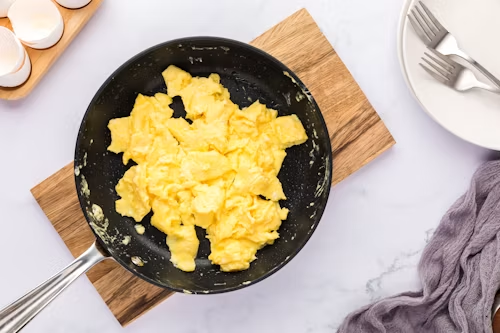
If your dog gives you those irresistible puppy-dog eyes while you’re making breakfast, you may wonder, can dogs eat scrambled eggs? The good news is that for most healthy dogs, the answer is yes—but there is an important catch.
Scrambled eggs are safe for dogs when they are fully cooked, plain, and served in moderation. In fact, eggs can provide high-quality protein, healthy fats, vitamins, and minerals. Veterinary and pet-health sources commonly recommend cooked eggs as an occasional treat rather than feeding them raw or undercooked.
The problem is that the scrambled eggs sitting on your breakfast plate may contain much more than egg. Butter, oil, salt, pepper, cheese, milk, onion, garlic, and other seasonings can turn a simple egg into something that is less appropriate—or potentially harmful—for a dog.
That’s why how you prepare scrambled eggs matters just as much as the egg itself.
A plain scrambled egg cooked without butter, oil, salt, or seasonings is very different from a restaurant-style breakfast scramble loaded with cheese, bacon, butter, and spices.
There is another important point: cooked eggs are preferable to raw or undercooked eggs. Raw eggs can carry bacteria such as Salmonella, while raw egg whites contain avidin, which can interfere with biotin absorption when consumed regularly.
In this guide, we’ll look at everything dog owners need to know about scrambled eggs for dogs. We’ll cover their nutritional benefits, safe ingredients, portion sizes, puppies, senior dogs, allergies, sensitive stomachs, health conditions, and the easiest way to prepare a dog-friendly scrambled egg.
So, let’s start with the question you’re probably most interested in.
Yes, dogs can eat scrambled eggs when they are fully cooked, plain, and served in moderation.
According to current guidance from the American Kennel Club and PetMD, scrambled eggs can be an appropriate food for dogs when prepared without oil, butter, salt, or seasonings.
That means a dog-friendly scrambled egg should look very different from a typical human breakfast.
A safe scrambled egg for dogs should be:
Fully cooked
Plain
Free from onion and garlic
Free from excessive salt
Free from heavy seasonings
Prepared without unnecessary butter or oil
Served in an appropriate portion
Eggs should also be treated as a treat or food topper, not as a replacement for your dog’s complete and balanced diet. PetMD recommends keeping all treats combined to no more than about 10% of a dog’s daily calories, with the remaining calories coming from a complete and balanced food.
What about raw or undercooked scrambled eggs?
It’s better to avoid them.
Raw and undercooked eggs can expose dogs to bacteria such as Salmonella, and raw egg whites contain avidin, which can reduce biotin absorption. Thorough cooking addresses these concerns while still leaving the egg nutritionally useful.
Yes. Plain scrambled eggs can be a nutritious occasional treat for dogs.
Eggs contain several nutrients that dogs need, including high-quality protein, fatty acids, vitamins, and minerals. The American Kennel Club lists protein, iron, fatty acids, folate, riboflavin, selenium, vitamin A, and vitamin B12 among the nutrients eggs provide.
Purina also describes eggs as an excellent protein source and points out that eggs provide nutrients such as linoleic acid and vitamin A that can support skin and coat health.
However, “nutritious” does not mean that your dog needs a large serving.
An egg can be a useful addition to a balanced diet, but more is not necessarily better.
Nutritional Benefits of Scrambled Eggs
A plain cooked egg provides a variety of nutrients.
Nutrient
Potential Benefit for Dogs
Protein
Helps support muscles, tissues, growth, and repair
Vitamin A
Supports normal vision, skin, and immune function
Vitamin B12
Supports normal nervous-system and cellular functions
Riboflavin
Helps support energy metabolism
Folate
Involved in normal cell growth and blood-cell production
Iron
Supports normal oxygen transport
Selenium
Important for normal metabolism and antioxidant functions
Fatty acids
Help support normal skin and coat health
Healthy fats
Provide energy and help with absorption of fat-soluble nutrients
One reason eggs are popular with dog owners is that they’re both nutrient-dense and easy to prepare.
You can scramble one, let it cool, chop it into small pieces, and use a modest amount as a meal topper or occasional treat.
How Protein in Eggs Benefits Dogs
Protein plays a major role in a dog’s body.
Dogs use dietary protein to support muscle maintenance, tissue repair, growth, and many normal body functions. That’s particularly important for growing puppies, active adult dogs, and dogs recovering from certain illnesses.
Egg protein is also highly digestible and contains a broad range of essential amino acids.
That doesn’t mean eggs should become your dog’s main protein source. A properly formulated dog food already provides the necessary nutrients in the right proportions.
Instead, think of scrambled egg as a nutritious extra.
For example, adding a small amount of plain scrambled egg to your dog’s regular food can make the meal more exciting without replacing the nutritionally complete food that forms the foundation of their diet.
Can Scrambled Eggs Help a Dog’s Skin and Coat?
They can contribute to normal skin and coat health, but they aren’t a miracle treatment for skin problems.
Eggs contain protein, fatty acids, vitamin A, and other nutrients associated with maintaining healthy skin and fur. Purina specifically highlights nutrients in eggs that can support a dog’s skin and coat.
That said, a dull coat or itchy skin can have many different causes.
Possible causes include:
Allergies
Fleas or other parasites
Skin infections
Environmental sensitivities
Nutritional problems
Hormonal disorders
Other underlying illnesses
So if your dog has persistent itching, hair loss, recurring ear problems, or significant skin changes, simply adding scrambled eggs to the diet isn’t an appropriate substitute for veterinary care.
Eggs can be part of a healthy diet, but they should not be presented as a cure for dermatological disease.
Can Scrambled Eggs Help an Upset Stomach?
This is one of the reasons people often search for scrambled eggs for dogs with upset stomachs.
Interestingly, the American Kennel Club notes that cooked eggs can sometimes help settle an upset stomach.
However, that doesn’t mean scrambled eggs are the right treatment for every case of vomiting or diarrhea.
A dog can develop digestive problems for many reasons, including:
Eating something inappropriate
Sudden dietary changes
Food intolerance
Parasites
Infection
Pancreatitis
Foreign-body obstruction
Other medical conditions
If your dog has a mild digestive upset and your veterinarian has previously advised a particular diet, follow that advice rather than assuming eggs are the solution.
Seek veterinary attention for concerning signs such as repeated vomiting, severe or persistent diarrhea, blood in the stool, dehydration, marked weakness, severe abdominal pain, or loss of appetite.
What Makes Scrambled Eggs Safe or Unsafe for Dogs?
The egg itself isn’t usually the biggest issue.
The ingredients surrounding the egg are often what create the problem.
A plain egg cooked specifically for your dog can be perfectly reasonable. A plate of scrambled eggs made with butter, cheese, salt, garlic, onion, and bacon is a completely different situation.
Here’s how the most common ingredients compare.
Plain Scrambled Eggs
Plain scrambled eggs are the safest option.
For a dog-friendly preparation:
Crack the egg into a clean bowl.
Beat it lightly.
Cook it thoroughly.
Don’t add salt or seasonings.
Skip butter and unnecessary oil.
Let it cool before serving.
Give an appropriate portion.
The American Kennel Club specifically recommends cooking eggs plain, without oil, butter, salt, seasonings, or spices.
This is one of those situations where simple really is better.
Scrambled Eggs With Butter
Can dogs eat scrambled eggs with butter?
It’s better not to add butter.
A small accidental amount of butter is not generally considered a poisoning emergency, but intentionally cooking your dog’s eggs in butter adds unnecessary fat and calories. PetMD notes that butter is unhealthy for dogs and may cause stomach upset, particularly when larger amounts are consumed.
This matters because dogs don’t need butter to obtain the benefits of eggs.
Adding it can also be particularly undesirable for dogs that need careful fat management.
Why skip the butter?
It adds extra calories.
It increases the fat content of the meal.
It may trigger digestive upset in some dogs.
Rich foods can be a poor choice for dogs prone to pancreatitis.
If you’re making scrambled eggs specifically for your dog, there’s no good reason to add butter.
Scrambled Eggs With Oil
What about cooking the egg with olive oil or another cooking oil?
Again, plain is usually better.
A small amount of cooking oil may not be toxic, but it adds calories and fat that your dog doesn’t need to get from a simple egg.
A nonstick pan can make it possible to scramble an egg without added fat. You can also cook the egg using another method that doesn’t require butter or oil.
Remember that dogs don’t need their food prepared exactly the way people eat it.
The goal isn’t to make a restaurant-quality breakfast.
The goal is to provide a simple, safe treat.
Scrambled Eggs With Salt
It’s best to leave the salt shaker alone.
Dogs require sodium as part of their normal nutrition, but they do not need you to add salty seasonings to a scrambled egg prepared as a treat.
Heavily salted human food can contribute unnecessary sodium, and it is simply easier to avoid the issue by keeping the egg plain.
So instead of asking, “How much salt is safe for my dog?” the better approach is:
Why add salt at all?
A plain egg is already appealing to many dogs.
Scrambled Eggs With Pepper and Spices
Pepper and other spices aren’t necessary for your dog’s scrambled eggs.
Some seasonings can cause stomach irritation, while others may contain ingredients that are dangerous to dogs.
This is particularly important because spice blends can contain multiple ingredients. What appears to be “just seasoning” may actually contain onion powder, garlic powder, excessive sodium, or other ingredients that shouldn’t be part of your dog’s meal.
When cooking for your pet, it’s much safer to keep the ingredient list short.
Egg is enough.
Scrambled Eggs With Onion or Garlic
No—avoid adding onion or garlic to scrambled eggs for dogs.
This is one of the most important differences between a human breakfast and a dog-friendly breakfast.
Onion and garlic belong to the Allium group of plants and can be harmful to dogs. Concentrated forms such as powders can also be found in seasoning mixes and prepared foods.
That means you should not simply give your dog a bite from a plate of scrambled eggs cooked with onion or garlic.
This is especially relevant to searches such as:
dogs and scrambled eggs with onion
can dogs eat eggs with garlic
scrambled eggs for dogs with seasoning
The safest answer is straightforward: leave onion and garlic out completely.
Can Dogs Eat Plain Scrambled Eggs?
Yes.
Plain scrambled eggs are one of the easiest egg preparations to offer a dog.
“Plain” means the egg is:
Fully cooked
Prepared without butter
Prepared without unnecessary oil
Free of salt
Free of pepper and spices
Free of onion and garlic
Served without rich sauces or toppings
Let the egg cool before serving, particularly if it has just come out of the pan.
Then start with a small portion.
If your dog has never eaten eggs before, don’t assume they need an entire egg. A few small pieces are enough to see whether they tolerate the food.
Dogs can have individual food sensitivities, so introducing a new food gradually makes sense.
PetMD likewise recommends starting with a small quantity and monitoring for signs of allergies or digestive upset before increasing the amount.
Can Dogs Eat Scrambled Eggs With Milk?
You may be used to adding milk to scrambled eggs to make them softer or creamier.
For dogs, though, milk isn’t necessary.
Some dogs tolerate dairy products reasonably well, while others have difficulty digesting lactose and may develop:
Gas
Loose stools
Diarrhea
Abdominal discomfort
If the goal is simply to give your dog scrambled egg, there is no nutritional need to add milk.
A better option
Scramble the egg without milk.
You can add a small amount of water if desired, but even that isn’t necessary.
Keeping the recipe simple makes it easier to control calories and ingredients and reduces the chance of a digestive reaction.
If your dog already has a known sensitivity to dairy, there’s even more reason to leave milk out.
Can Dogs Eat Scrambled Eggs With Cheese?
Cheese is another common scrambled-egg ingredient that deserves caution.
A little plain cheese may not cause a serious problem in every dog, but cheese can add:
Fat
Calories
Sodium
Dairy
Some dogs also have difficulty tolerating dairy products.
If you combine eggs with a large amount of cheese, the result becomes much richer than the plain egg your dog actually needs.
What about flavored or processed cheese?
These products can contain additional salt, seasonings, spices, or other ingredients.
For that reason, plain scrambled eggs are a much better choice than cheesy breakfast eggs.
If you do offer any dairy product to your dog, it should be compatible with their individual diet and tolerance.
Can Dogs Eat Scrambled Eggs With Butter?
Technically, a dog may eat a small amount of egg cooked in butter without immediately becoming ill. But that doesn’t make butter a good ingredient for routine dog treats.
As mentioned earlier, butter adds a substantial amount of fat compared with a plain egg. PetMD recommends avoiding intentionally feeding butter to dogs because it is unhealthy and may contribute to digestive problems.
This becomes more important when a dog has a history of pancreatitis or needs a lower-fat diet.
The better choice
Use a nonstick pan and scramble the egg without butter.
Your dog is unlikely to complain about the missing butter.
Most dogs care much more about getting the egg than whether it was cooked like a restaurant breakfast.
Can Dogs Eat Scrambled Eggs With Oil?
The same principle applies to oil.
You don’t need to add oil simply because you’re cooking eggs for a human meal.
A large amount of added oil increases calories and fat without providing a meaningful reason to do so.
Plain vs. oil-cooked scrambled eggs
Feature
Plain Scrambled Egg
Egg With Added Oil
Protein
✅ Yes
✅ Yes
Nutrients from egg
✅ Yes
✅ Yes
Extra calories
Lower
Higher
Added fat
Minimal
Higher
Simple to portion
✅ Yes
✅ Yes
Best choice for dogs
✅ Preferred
⚠️ Usually unnecessary
For a healthy dog, a tiny amount of oil used during cooking is unlikely to make an egg suddenly toxic. But when you’re deliberately preparing a treat for your dog, there is simply no need to add it.
Can Dogs Eat Scrambled Eggs With Salt and Pepper?
Salt
Dogs don’t need salted scrambled eggs.
The complete food your dog eats should already provide the sodium they need in appropriate amounts. Adding table salt to an otherwise healthy treat is unnecessary.
If you’re cooking eggs for your dog, just leave it out.
Pepper
Black pepper isn’t a nutritional requirement either.
Although a tiny amount may not cause a serious problem in most dogs, pepper and spicy seasonings can cause digestive irritation in some pets.
Again, simplicity wins.
Plain scrambled eggs are easier, safer, and usually just as appealing to your dog.
Can Dogs Eat Scrambled Eggs With Onion or Garlic?
No. Keep onion and garlic out of your dog’s scrambled eggs.
This includes:
Fresh onion
Cooked onion
Garlic
Onion powder
Garlic powder
Seasoning blends containing onion or garlic
This is why sharing your own seasoned breakfast with your dog isn’t always a good idea.
Your scrambled eggs might contain ingredients that are perfectly normal in human cooking but unsuitable for canine consumption.
If you’re making a separate serving for your dog, reserve a portion of the egg before adding any seasoning.
That simple habit can prevent accidental exposure.
Can Dogs Eat Scrambled Eggs Every Day?
This question doesn’t have a universal yes-or-no answer because the right amount depends on the individual dog.
But for most dogs, scrambled eggs are better treated as an occasional treat rather than an automatic daily staple.
Eggs are nutritious, but they also contain calories.
PetMD recommends that all treats combined make up no more than about 10% of a dog’s daily calories, with the rest supplied by a nutritionally complete and balanced diet.
Purina similarly emphasizes using eggs as a treat and considering their calorie contribution.
Feeding too many eggs may contribute to:
Excess calorie intake
Weight gain
Digestive upset
Too many dietary extras
Reduced appetite for regular food
An unbalanced overall diet
A dog that needs 300 calories a day obviously has very different nutritional needs from a dog that needs 1,000 or more.
That’s why you shouldn’t use a universal rule such as “every dog can have one egg every day.”
Some dogs may tolerate small amounts frequently, while others may be better suited to occasional servings.
For dogs with medical conditions or prescription diets, discuss eggs with your veterinarian before making them a regular part of the diet. PetMD specifically advises consulting a veterinarian before introducing new foods, particularly for dogs with health conditions or dogs eating prescription diets.
How Many Scrambled Eggs Can a Dog Eat?
The right portion depends on the individual dog.
Important factors include:
Body size
Age
Activity level
Current weight
Health status
Existing diet
Daily calorie requirements
PetMD provides size-based examples for egg portions, while emphasizing that portions should be considered in relation to a dog’s overall calorie needs.
General Starting Portions
Dog Size
General Starting Portion
Small dog
A few small bites or a fraction of an egg
Medium dog
Around ½ egg as an occasional treat
Large dog
Around 1 egg as an occasional treat
Extra-large dog
Amount based on individual calorie requirements
These are starting points, not universal prescriptions.
A small, inactive dog may need much less than an energetic large breed. Likewise, an overweight dog may need smaller portions than a lean, highly active dog.
The best approach is to start small and consider the egg as part of the dog’s overall daily calorie intake.
One large egg contains roughly dozens of calories on its own, so regularly feeding several eggs can add up quickly. Purina estimates an egg at about 70 calories.
How to Make Scrambled Eggs for Dogs
Making scrambled eggs for your dog is surprisingly easy.
You don’t need a special dog-food recipe or expensive ingredients.
Step 1: Crack a Fresh Egg
Use a fresh egg and crack it into a clean bowl.
Step 2: Beat the Egg
Whisk or beat the egg lightly until the yolk and white are combined.
You can add a tiny amount of water if you like, but there is no need for milk or cream.
Step 3: Skip Butter, Oil, Salt, and Seasonings
This is the most important preparation rule.
Don’t add:
Butter
Excess oil
Salt
Pepper
Garlic
Onion
Hot sauce
Seasoning blends
Step 4: Cook Thoroughly
Cook the egg until the white and yolk are fully set.
Avoid leaving the egg runny or undercooked.
Current veterinary guidance recommends fully cooking eggs before feeding them to dogs.
Step 5: Let It Cool
Don’t give your dog an egg straight from a hot pan.
Allow it to cool to a safe temperature.
Step 6: Cut Into Small Pieces
For smaller dogs especially, breaking the egg into small pieces makes portion control easier.
Step 7: Serve a Small Portion
Give only an amount appropriate for your dog’s size and daily calorie needs.
You can serve the egg:
By itself as a treat
Mixed into regular kibble
As a small meal topper
In a food puzzle or enrichment toy
The egg should remain an addition to the regular diet, not become the main meal.
Dog-Friendly Scrambled Egg Recipe
Want the simplest possible recipe?
Here it is.
Ingredients
1 fresh egg
Optional: a small amount of water
That’s it.
Instructions
Crack the egg into a clean bowl.
Beat it lightly with a fork.
Heat a suitable nonstick pan.
Add the egg without butter or seasoning.
Stir gently while cooking.
Cook until the egg is completely set.
Remove from the heat.
Let it cool.
Cut or break it into small pieces.
Serve an appropriate portion to your dog.
Ingredients to Avoid
Do not turn your dog’s simple scrambled egg into a human breakfast by adding:
❌ Salt
❌ Pepper
❌ Onion
❌ Garlic
❌ Hot sauce
❌ Butter
❌ Excess oil
❌ Heavy cream
❌ Rich cheese
❌ Bacon or processed meats
The fewer unnecessary ingredients you use, the easier it is to know exactly what your dog is eating.
A Simple Rule for Dog-Friendly Scrambled Eggs
When you’re standing in the kitchen wondering whether the ingredients in your scrambled eggs are okay for your dog, remember this:
If the egg needs several toppings to taste good to you, make a separate plain portion for your dog.
Your dog doesn’t need butter, salt, pepper, cheese, garlic, or bacon to enjoy a scrambled egg.
A plain, fully cooked egg in a sensible portion is the safer and simpler choice.
Can Puppies Eat Scrambled Eggs?
Puppies can be curious little food critics. If they see you preparing scrambled eggs, they may quickly decide that breakfast should be shared.
The good news is that plain, fully cooked scrambled eggs can be appropriate for some puppies in small amounts. However, puppies have very specific nutritional requirements because their bodies are growing rapidly.
Their primary food should always be a complete and balanced puppy diet formulated for their age and expected adult size.
Are Scrambled Eggs Safe for Puppies?
Yes, a small amount of plain, fully cooked egg can be offered to many healthy puppies as an occasional treat.
The key is moderation.
Avoid giving a puppy raw or undercooked egg, heavily seasoned eggs, or scrambled eggs containing butter, onion, garlic, or other unnecessary ingredients.
When introducing any new food to a puppy, start with a very small amount. A young puppy’s digestive system may be more sensitive to sudden dietary changes.
How Much Scrambled Egg Can a Puppy Eat?
There is no single portion that works for every puppy.
A puppy’s appropriate amount depends on:
Age
Breed
Current body weight
Expected adult size
Activity level
Existing diet
Overall health
For a very young or small puppy, a few tiny pieces may be plenty for the first introduction.
Don’t assume that because an adult dog can eat half an egg, a puppy should receive the same amount.
Can Puppies Eat Scrambled Eggs Every Day?
Usually, there is no need to feed eggs every day.
Puppy food is specifically formulated to provide the nutrients needed for growth. Too many extras can add calories and potentially interfere with the nutritional balance of the main diet.
A few pieces of plain scrambled egg occasionally can be a treat. It should not replace your puppy’s regular food.
Can Senior Dogs Eat Scrambled Eggs?
Older dogs can often enjoy plain scrambled eggs in moderation, provided they are healthy and the eggs fit into their overall diet.
Eggs can provide protein and other nutrients, which may be useful as part of an appropriate diet. However, senior dogs often have changing nutritional needs.
Some become less active and need fewer calories. Others develop medical conditions that require specific dietary adjustments.
Benefits for Senior Dogs
A small amount of cooked egg can provide:
High-quality protein
Vitamin B12
Riboflavin
Selenium
Vitamin A
Other nutrients
Protein is particularly important for maintaining normal body tissues and muscle.
However, that doesn’t mean older dogs need large amounts of egg.
Weight Management Matters
An older dog that has become less active may gain weight more easily.
Adding eggs, cheese, butter, or other calorie-rich foods on top of regular meals can gradually increase daily calorie intake.
For an overweight senior dog, a few small pieces may be more appropriate than a full egg.
Senior Dogs With Medical Conditions
Some senior dogs develop conditions such as:
Kidney disease
Liver disease
Diabetes
Pancreatitis
Obesity
Gastrointestinal disease
In those cases, dietary choices should be individualized.
A food that is appropriate for a healthy senior dog may not be suitable for a dog receiving a prescription diet.
Can Dogs With Health Conditions Eat Scrambled Eggs?
The answer depends on the condition.
For a healthy dog, plain cooked egg can be a reasonable occasional treat. But certain diseases require careful control of nutrients such as fat, protein, phosphorus, calories, or carbohydrates.
That’s why it’s important not to assume that a nutritious food is automatically suitable for every dog.
Scrambled Eggs for Dogs With Pancreatitis
Pancreatitis involves inflammation of the pancreas, and dietary fat can be an important consideration in affected dogs.
Egg yolks contain fat, and adding butter, oil, cheese, or other rich ingredients can increase the fat content even further.
For a dog with a history of pancreatitis, avoid turning scrambled eggs into a high-fat meal.
If your veterinarian has recommended a low-fat or therapeutic diet, follow that plan instead of adding eggs without approval.
If Eggs Are Allowed
The safest preparation would generally be:
Fully cooked
Plain
No butter
No oil
No cheese
Very small portion
However, whether an egg is appropriate at all should be decided according to the dog’s individual medical situation.
Scrambled Eggs for Dogs With Kidney Disease
Kidney disease requires especially careful nutritional management.
Depending on the dog’s condition and disease stage, a veterinarian may recommend controlling nutrients such as:
Phosphorus
Protein
Sodium
Calories
Eggs contain protein and phosphorus, so adding them casually to a dog with chronic kidney disease may not be appropriate.
A dog receiving a prescription kidney diet should generally remain on that nutritional plan unless the veterinarian recommends additions or alternatives.
Why Individual Advice Matters
Two dogs with kidney disease can have very different bloodwork, disease stages, appetite, weight, and nutritional requirements.
So there is no universal rule saying:
“Dogs with kidney disease can have exactly this much egg.”
Instead, ask your veterinarian whether scrambled egg can fit into your dog’s specific nutritional plan.
Scrambled Eggs for Dogs With Diabetes
Dogs with diabetes benefit from consistent, predictable nutrition.
Randomly adding calorie-dense treats can make it more difficult to maintain an appropriate feeding routine.
Plain scrambled egg may be suitable for some dogs, but the amount should be considered within the dog’s total daily calorie intake and feeding schedule.
If your diabetic dog receives insulin or other treatment, sudden changes in food intake can be particularly important.
Never use scrambled eggs as a substitute for a prescribed diabetic diet.
Scrambled Eggs for Overweight Dogs
An egg is nutritious, but it still contains calories.
For overweight dogs, the goal is not to eliminate every treat. Instead, treats should be carefully portioned so they don’t undermine the overall weight-management plan.
Consider offering:
A few pieces of scrambled egg rather than a whole egg
Egg as a training reward
Egg instead of another higher-calorie treat
You can also chop a small portion into many tiny pieces, making one egg go further during training.
The trick is portion size, not simply whether the food is “healthy.”
A healthy food can still contribute to weight gain when too much is fed.
Scrambled Eggs for Dogs With Sensitive Stomachs
Some dogs tolerate plain cooked eggs quite well, while others may develop loose stool, gas, or vomiting after eating them.
If your dog has a sensitive stomach, introduce eggs cautiously.
A sensible approach is:
Offer a very small amount.
Use plain, fully cooked egg.
Avoid butter, cheese, milk, and seasoning.
Monitor stool and appetite.
Stop if symptoms develop.
If your dog repeatedly experiences digestive problems, don’t keep experimenting with different foods.
Persistent gastrointestinal symptoms deserve a veterinary evaluation.
Can Dogs Be Allergic to Eggs?
Yes, dogs can develop food allergies to eggs.
An allergy occurs when the immune system reacts to a protein in the food. Food allergies can produce symptoms involving the skin, ears, gastrointestinal tract, or other systems.
Possible Signs of an Egg Allergy
Your dog may develop:
Persistent itching
Red or inflamed skin
Paw licking
Recurrent ear irritation
Hair loss or skin changes
Vomiting
Diarrhea
Digestive discomfort
However, these symptoms don’t automatically mean eggs are responsible.
Dogs can have similar signs because of:
Flea allergies
Environmental allergies
Other food allergies
Parasites
Skin infections
Gastrointestinal disease
Egg Allergy vs. Food Intolerance
A food allergy involves an immune response.
A food intolerance generally involves difficulty digesting or tolerating a food without the same type of immune mechanism.
For example, a dog may develop diarrhea after eating a rich food without actually having an allergy.
If symptoms repeatedly occur after egg consumption, stop feeding eggs and speak with your veterinarian.
A veterinarian can help determine whether an elimination diet or other diagnostic approach is appropriate.
Scrambled Eggs and Food Safety
How you store and serve scrambled eggs matters just as much as how you cook them.
Eggs are animal products, and proper handling helps reduce bacterial contamination.
Why Eggs Should Be Fully Cooked
One of the primary reasons to cook eggs thoroughly is the risk of Salmonella and other foodborne bacteria.
Raw and undercooked eggs can carry harmful bacteria. Fully cooking the egg reduces this risk.
For this reason, avoid treating your dog to runny scrambled eggs simply because you personally prefer them that way.
Can Dogs Eat Runny Scrambled Eggs?
It is better to avoid runny or undercooked scrambled eggs.
The white and yolk should be cooked until fully set.
Even though some people prefer soft, creamy scrambled eggs, that style isn’t necessary for dogs.
A thoroughly cooked egg gives your dog the nutritional benefits of egg without unnecessarily increasing the exposure associated with undercooked egg.
So when preparing scrambled eggs for a dog:
Cook them fully.
Can Dogs Eat Leftover Scrambled Eggs?
Yes, properly stored leftover scrambled eggs can be offered to a dog, provided they were originally prepared with dog-safe ingredients and stored safely.
The biggest issue is freshness.
Don’t feed your dog scrambled eggs that:
Have been left sitting out for an extended period
Smell spoiled
Look unusual
Contain ingredients that are unsafe for dogs
Have been stored improperly
Safe Storage
Place leftover scrambled eggs in a clean, covered container and refrigerate them promptly.
When serving leftovers, make sure the food is fresh and hasn’t been contaminated during storage.
And remember: if the original scrambled eggs contained onion, garlic, excessive seasoning, or a heavy amount of butter, don’t feed those leftovers to your dog simply because they are already cooked.
Can Dogs Eat Cold Scrambled Eggs?
Yes, dogs can generally eat properly cooked and safely refrigerated scrambled eggs while cold.
There is no requirement that cooked egg be warm when served.
In fact, allowing freshly cooked eggs to cool before giving them to your dog is a good way to avoid accidental burns.
The important factors are:
The egg was fully cooked.
It was stored safely.
It hasn’t spoiled.
It doesn’t contain harmful ingredients.
The portion is appropriate.
Temperature is much less important than food safety and preparation.
Scrambled Eggs vs. Other Egg Preparations for Dogs
Eggs can be prepared in many ways, but not every method is equally suitable for dogs.
Preparation
Dog-Friendly?
Main Consideration
Plain scrambled
✅ Yes
Fully cooked and plain
Boiled
✅ Yes
Simple and easy to portion
Poached
✅ If fully cooked
Avoid runny egg
Fried
⚠️ Use caution
Oil or butter may add unnecessary fat
Raw
❌ Avoid
Salmonella and avidin concerns
Soft-boiled
⚠️ Better avoided
May remain undercooked
Plain omelet
⚠️ Depends
Avoid harmful fillings and seasonings
Why Plain Scrambled Eggs Are Convenient
Scrambled eggs have a practical advantage: they’re easy to portion into tiny pieces.
For example, rather than giving a small dog half an egg at once, you can give just a few pieces as treats throughout the day.
Boiled eggs are also excellent because they require no added cooking fat and are easy to refrigerate.
Ultimately, the preparation you choose matters less than following the basic safety rules.
Raw Eggs vs. Scrambled Eggs for Dogs
Raw eggs and plain scrambled eggs contain many of the same basic nutrients, but their safety profiles are different.
Factor
Raw Egg
Plain Scrambled Egg
Protein
Yes
Yes
Vitamins and minerals
Yes
Yes
Salmonella concern
Higher
Much lower when fully cooked
Avidin in raw white
Present
Reduced/deactivated through cooking
Added ingredients
Usually none
Should remain plain
Food-safety control
Lower
Higher
Recommended
❌ Generally avoid
✅ In moderation
There’s an old idea that dogs need raw eggs to receive their “natural” benefits.
That’s unnecessary.
Cooking an egg provides a simple way to reduce avoidable food-safety risks while maintaining its nutritional usefulness.
For most dog owners, there is little reason to choose the riskier option.
Are Scrambled Eggs Better Than Boiled Eggs for Dogs?
Both can be good choices when prepared correctly.
Scrambled eggs
Advantages:
Easy to mix with food
Easy to break into tiny pieces
Convenient for training rewards
Quick to prepare
Potential downside:
People often add butter, oil, cheese, milk, or seasonings
Boiled eggs
Advantages:
No cooking fat is necessary
Easy to prepare in batches
Convenient to refrigerate
Easy to portion
Potential downside:
Some dogs may receive larger portions because the whole egg is already prepared
Nutritionally, plain scrambled and plain boiled eggs are both reasonable options.
The best choice is the one you can prepare safely and portion appropriately.
Can Scrambled Eggs Help Dogs Gain Weight?
Because eggs contain protein and calories, some owners wonder whether they can help an underweight dog gain weight.
A small amount can contribute calories, but scrambled eggs should not be the primary strategy for weight gain.
An unexplained loss of weight can be a sign of:
Dental disease
Digestive disease
Parasites
Diabetes
Kidney disease
Liver disease
Cancer
Other underlying problems
If a dog is underweight or unexpectedly losing weight, the priority should be finding out why.
Once an underlying condition has been addressed, a veterinarian can recommend an appropriate feeding strategy.
Adding eggs indiscriminately may provide calories but doesn’t necessarily provide the right balance of nutrients.
Can Scrambled Eggs Help Dogs With an Upset Stomach?
But not every upset stomach should be treated by feeding eggs.
If your dog has mild, short-lived digestive upset, speak with your veterinarian about appropriate feeding instructions.
More serious symptoms require professional evaluation.
Warning signs include:
Repeated vomiting
Blood in vomit or stool
Severe diarrhea
Persistent diarrhea
Severe abdominal pain
Marked lethargy
Dehydration
Refusal to drink
Refusal to eat
Collapse or significant weakness
A dog with repeated vomiting or diarrhea can become dehydrated quickly, particularly if they are very young, elderly, or already medically compromised.
Common Mistakes When Feeding Scrambled Eggs to Dogs
Even well-meaning owners can accidentally make scrambled eggs less suitable for their pets.
1. Sharing Seasoned Human Eggs
Your breakfast may contain several ingredients that don’t belong in a dog’s diet.
2. Adding Butter
Butter adds unnecessary fat and calories.
3. Adding Oil
Oil isn’t needed to make a dog-friendly egg.
4. Adding Milk or Cream
Some dogs have difficulty digesting dairy, and neither ingredient is necessary.
5. Adding Cheese
Cheese can increase calories, fat, and sodium.
6. Adding Onion
Onion should not be included in dog food.
7. Adding Garlic
Garlic is another ingredient that should be avoided.
8. Serving Eggs Too Frequently
Even a nutritious treat can become excessive when given too often.
9. Giving a Portion That Is Too Large
A whole egg may be a modest amount for a large dog but a significant treat for a small dog.
10. Feeding Undercooked Eggs
Choose thoroughly cooked eggs instead.
11. Ignoring Allergic or Digestive Reactions
If your dog repeatedly develops itching, vomiting, or diarrhea after eggs, don’t continue feeding them without investigating the cause.
12. Giving Eggs to a Dog on a Prescription Diet Without Approval
Prescription diets are formulated for specific medical needs. Unplanned extras may interfere with the dietary goals.
Myths About Scrambled Eggs for Dogs
Myth 1: Scrambled Eggs Are Automatically Safe No Matter How They’re Prepared
False.
The egg may be safe, but the ingredients added to it can create problems.
Plain cooked egg is very different from scrambled eggs containing onion, garlic, butter, excessive salt, or rich sauces.
Myth 2: Dogs Need Eggs Every Day
False.
Dogs can obtain the nutrients they need from a complete and balanced diet.
Eggs are optional treats or additions, not nutritional requirements for every dog.
Myth 3: Butter Makes Eggs Healthier for Dogs
False.
Butter simply adds fat and calories.
Dogs do not need butter to benefit from eggs.
Myth 4: Dogs Need Salt on Their Eggs
False.
A dog’s complete diet already contains appropriate sodium.
Adding table salt to scrambled eggs isn’t necessary.
Myth 5: Raw Eggs Are Healthier Than Scrambled Eggs
Not supported by a need-based feeding approach.
Raw eggs carry avoidable food-safety concerns, while fully cooked eggs still provide protein and nutrients.
There’s no general reason to choose raw eggs over cooked ones.
Myth 6: A Whole Egg Is a Small Treat for Every Dog
False.
Dogs differ dramatically in size and calorie requirements.
A whole egg can represent a much larger proportion of daily calories for a small dog than for a large breed.
Myth 7: Scrambled Eggs Can Replace Dog Food
False.
Eggs are nutritious but don’t provide the complete nutrient balance required by a dog as its sole food.
Myth 8: Eggs Cure Skin Problems
False.
Eggs can contribute nutrients involved in skin and coat health, but persistent itching, redness, hair loss, or ear problems need proper diagnosis.
Myth 9: Every Dog With Diarrhea Should Be Fed Eggs
False.
Some dogs may tolerate plain cooked egg, but diarrhea can have many causes.
Persistent or severe digestive symptoms require veterinary advice.
Myth 10: Eggshells Should Always Be Added for Calcium
False.
Eggshells contain calcium, but indiscriminate calcium supplementation can create nutritional imbalance.
If a dog needs supplementation, it should be appropriately calculated.
Frequently Asked Questions About Dogs and Scrambled Eggs
Can dogs eat scrambled eggs?
Yes. Most healthy dogs can eat plain, fully cooked scrambled eggs in moderation.
Are scrambled eggs good for dogs?
They can be. Eggs provide protein, fats, vitamins, and minerals, making plain cooked scrambled egg a nutritious occasional treat.
Can dogs eat plain scrambled eggs?
Yes. Plain scrambled eggs without salt, onion, garlic, butter, heavy oil, or seasonings are the preferred preparation.
Can dogs eat scrambled eggs with butter?
It’s better to avoid butter. It adds unnecessary fat and calories and may be unsuitable for dogs that need a lower-fat diet.
Can dogs eat scrambled eggs with oil?
A small amount of oil isn’t automatically toxic, but it isn’t necessary. Plain eggs are the simpler choice.
Can dogs eat scrambled eggs with milk?
It’s better to prepare eggs without milk. Some dogs don’t tolerate dairy well, and milk isn’t necessary for scrambled eggs.
Can dogs eat scrambled eggs with cheese?
Small amounts of plain cheese may be tolerated by some dogs, but cheese adds fat, calories, and often sodium. Plain eggs are preferable.
Can dogs eat scrambled eggs with salt?
Dogs don’t need additional salt in their scrambled eggs. Leave it out.
Can dogs eat scrambled eggs with pepper?
There is no nutritional reason to add pepper. Plain eggs are a better option.
Can dogs eat scrambled eggs with onion?
No. Avoid onion. Onion can be harmful to dogs and should not be included in scrambled eggs prepared for them.
Can dogs eat scrambled eggs with garlic?
No. Garlic should not be added to a dog’s scrambled eggs.
How should I cook scrambled eggs for my dog?
Crack a fresh egg, beat it lightly, cook it thoroughly without butter, salt, oil, onion, garlic, or seasoning, then allow it to cool before serving.
Can puppies eat scrambled eggs?
Yes, small amounts of plain, fully cooked egg can be suitable for some healthy puppies. Their primary diet should remain complete and balanced puppy food.
Can senior dogs eat scrambled eggs?
Healthy senior dogs can often tolerate small portions. Dogs with kidney disease, pancreatitis, diabetes, or other conditions may require veterinary guidance.
Can dogs eat scrambled eggs every day?
They don’t need to. Eggs are generally best treated as an occasional food or treat unless your veterinarian recommends otherwise.
How much scrambled egg can a dog eat?
It depends on the dog’s size, calorie needs, activity, weight, health, and existing diet. Start with a small amount.
Can scrambled eggs help a dog’s upset stomach?
They may be tolerated by some dogs and can sometimes help settle a mild upset stomach, but vomiting or diarrhea can have many causes.
Can scrambled eggs cause diarrhea in dogs?
Yes. Some dogs may develop digestive upset after eating eggs, especially if the portion is large or the egg is prepared with rich ingredients.
Can dogs be allergic to eggs?
Yes. Dogs can develop food allergies to eggs and may show itching, skin problems, ear problems, vomiting, or diarrhea.
Are scrambled eggs better than boiled eggs for dogs?
Both can be good choices when fully cooked and plain. Boiled eggs are often simpler because they don’t require butter or oil.
Can dogs eat cold scrambled eggs?
Yes, provided the eggs were fully cooked, safely refrigerated, fresh, and prepared with dog-safe ingredients.
Can dogs eat leftover scrambled eggs?
Yes, if they were prepared safely, refrigerated promptly, and remain fresh. Don’t feed leftovers containing harmful ingredients such as onion or garlic.
Can dogs eat runny scrambled eggs?
It’s better to avoid runny or undercooked scrambled eggs. Fully cooked eggs are the safer choice.
Can dogs eat scrambled eggs with cheese and bacon?
This is not an ideal dog treat. Bacon and cheese add substantial fat, calories, and sodium, while prepared versions may contain additional seasonings.
Can dogs eat scrambled eggs for breakfast?
Yes. A small amount of plain scrambled egg can be offered at breakfast as an occasional topper or treat.
Can dogs with pancreatitis eat scrambled eggs?
Dogs with pancreatitis may need strict fat control. Ask your veterinarian before feeding eggs, especially egg yolks or eggs prepared with butter or oil.
Can dogs with diabetes eat scrambled eggs?
Some diabetic dogs may be able to eat small portions, but their diet should be consistent and carefully managed with veterinary guidance.
Can dogs with kidney disease eat scrambled eggs?
Kidney diets can require careful control of protein and phosphorus. Discuss eggs with your veterinarian before adding them.
Are scrambled eggs safe for dogs with sensitive stomachs?
Some dogs tolerate them, but others may experience digestive upset. Start with a very small amount and keep the egg completely plain.
Conclusion: Can Dogs Eat Scrambled Eggs?
So, can dogs eat scrambled eggs? Yes. For most healthy dogs, plain, fully cooked scrambled eggs can be a nutritious occasional treat. Eggs provide high-quality protein, vitamins, minerals, and fatty acids, making them a useful addition to an otherwise complete and balanced diet.
However, the way you prepare the eggs makes all the difference.
The safest scrambled eggs for dogs are simple and fully cooked. Avoid adding butter, excessive oil, salt, pepper, onion, garlic, hot sauce, rich cheese, cream, or other heavy ingredients. These additions can increase calories, fat, sodium, or introduce ingredients that are unsafe for dogs.
Portion size matters, too. A whole egg may be reasonable for some large dogs but far too much as a routine treat for a small dog. Consider your dog’s size, age, activity level, weight, health, and regular diet when deciding how much to offer.
Puppies and senior dogs can often tolerate small portions of plain cooked egg, but dogs with pancreatitis, kidney disease, diabetes, obesity, allergies, or other medical conditions may need individualized nutritional guidance.