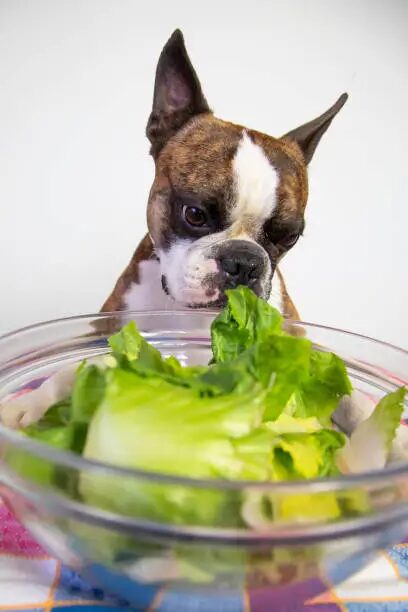
If your dog stares at you while you prepare a salad, you may wonder whether sharing a little lettuce is actually safe. After all, lettuce is a simple vegetable that humans eat regularly, and dogs can enjoy many fruits and vegetables as occasional treats. But not every human food is suitable for dogs, and even dog-friendly vegetables need to be served correctly.
So, can dogs eat lettuce? In most cases, yes. Plain lettuce is generally considered safe for healthy dogs when offered in moderation. Common varieties such as romaine, iceberg, arugula, green leaf, and red leaf lettuce are not considered toxic to dogs. Lettuce is also mostly water and relatively low in calories, making it a light snack for some dogs.
The important word here is plain.
A small piece of washed lettuce is very different from a bowl of leftover Caesar salad covered in dressing, cheese, garlic, or onions. Some ingredients commonly found in human salads can be dangerous to dogs. Onions, garlic, and chives, for example, should never be intentionally fed to dogs.
Preparation matters, too. A whole lettuce leaf can be awkward for a dog to chew or swallow, particularly for small dogs and fast eaters. Chopping or tearing lettuce into manageable pieces makes it easier to eat and can reduce choking concerns.
Lettuce can also provide some fiber, water, beta-carotene, vitamin A, vitamin K, and other micronutrients, although its nutritional value varies depending on the type. Romaine, for example, is generally more nutrient-dense than iceberg lettuce.
This guide explains everything you need to know about feeding lettuce to dogs, including safe varieties, nutritional benefits, serving sizes, raw versus cooked lettuce, puppies, salads, dressings, possible digestive problems, and safer ways to prepare it.
Quick Answer: Can Dogs Eat Lettuce?
Yes, most healthy dogs can eat plain lettuce in moderation.
Lettuce is generally nontoxic to dogs, and common varieties such as romaine, iceberg, and arugula can be offered as an occasional treat. It contains a lot of water, some fiber, and small amounts of vitamins and other nutrients.
However, lettuce isn’t a nutritional requirement for dogs. Your dog’s main meals should come from a complete and balanced dog food appropriate for their age, size, and health needs.
Think of lettuce as an optional extra rather than something your dog needs every day.
Is Lettuce Toxic to Dogs?
Plain lettuce is not considered toxic to dogs. The bigger concern is usually how much your dog eats and what has been added to it.
For example:
- Plain lettuce: Generally safe in moderation
- Washed and chopped lettuce: A good way to serve it
- Lettuce with onion: Unsafe
- Lettuce with garlic: Unsafe
- Lettuce with rich dressing: Best avoided
- Huge amounts of lettuce: May cause digestive upset
Why Can Lettuce Be a Useful Occasional Treat?
One of lettuce’s biggest advantages is that it is very low in calories and high in water. Lettuce is approximately 90% water, although its nutritional profile differs among varieties.
That makes it potentially useful as a small snack for dogs that enjoy crunchy vegetables, particularly when owners are trying to avoid calorie-dense human treats.
Still, low calorie does not mean unlimited. Too much lettuce can introduce more fiber than your dog’s digestive system is accustomed to and may result in loose stool, diarrhea, gas, or stomach discomfort.
Should Lettuce Replace Dog Food?
No.
Even though vegetables can contribute useful nutrients, dogs require a properly formulated diet containing appropriate amounts of protein, fat, vitamins, minerals, and other essential nutrients.
Featured-Snippet Answer
Can dogs eat lettuce? Yes. Most healthy dogs can safely eat small amounts of plain lettuce, including romaine and iceberg, when it is thoroughly washed and chopped into small pieces. Lettuce is mostly water, low in calories, and provides some fiber and nutrients. However, too much lettuce may cause digestive upset. Avoid lettuce prepared with onions, garlic, rich dressings, or other unsafe ingredients.
Is Lettuce Safe for Dogs?
For most healthy dogs, plain lettuce is a safe occasional food. The key is to keep servings modest and prepare the vegetable properly.
Dogs have different nutritional requirements from humans, so a vegetable being healthy for people doesn’t automatically mean it should become a major part of a dog’s diet.
Fortunately, lettuce is relatively simple. When it is fresh, thoroughly washed, plain, and cut into appropriate pieces, it can be a reasonable occasional snack.
Is Lettuce Toxic to Dogs?
No, plain lettuce is generally not toxic to dogs.
Romaine, iceberg, and arugula are among the varieties specifically identified as generally safe. Lettuce’s high water content and relatively low calorie count make it a light option compared with many processed human snacks.
But there is an important distinction between “nontoxic” and “something your dog should eat freely.”
For example, a dog might tolerate a few chopped pieces without any problem but develop diarrhea after eating a large amount. That’s because lettuce contains fiber and a lot of water, and sudden increases in either can affect digestion.
So the safest approach is simple:
Offer a little, see how your dog responds, and don’t overdo it.
Can Dogs Eat Lettuce Every Day?
Technically, a healthy dog may tolerate small amounts of lettuce regularly, but there is usually no reason to feed lettuce every day.
Dogs don’t need lettuce to meet their nutritional requirements. Their primary nutrition should come from a complete and balanced diet.
Feeding large quantities every day can also increase the chance of:
- Loose stools
- Diarrhea
- Gas
- Abdominal discomfort
- Increased bowel movements
If you want to give your dog vegetables regularly, rotating different dog-safe options may be more sensible than relying heavily on one vegetable.
When Can Lettuce Be Unsafe for Dogs?
The lettuce itself is usually not the problem. Quantity, preparation, contamination, and additional ingredients are where the bigger concerns arise.
Eating Very Large Amounts
A dog that eats an entire bowl of lettuce may experience digestive upset. The combination of water and fiber can be too much for some dogs.
Large Leaves
A whole lettuce leaf may be difficult for some dogs to chew properly. This is especially true for:
- Toy breeds
- Puppies
- Dogs that gulp food
- Dogs with dental problems
Chopping lettuce into small pieces is a much better approach.
Sensitive Stomachs
Dogs with sensitive digestive systems may react to even relatively harmless vegetables. If your dog frequently experiences loose stool after dietary changes, introduce lettuce particularly cautiously.
Poorly Washed Lettuce
Lettuce With Unsafe Ingredients
This is one of the most important points.
Don’t assume that because lettuce is safe, a salad containing lettuce is also safe.
Human salads can contain:
- Onion
- Garlic
- Chives
- Grapes
- Raisins
- Heavy dressings
- Excess salt
- High-fat cheese
- Spicy seasonings
Some of these ingredients can be dangerous for dogs.
Dogs on Prescription Diets
If your dog is eating a prescription veterinary diet, don’t add lettuce or other foods without asking your veterinarian first.
Is Lettuce Good for Dogs?
Lettuce isn’t a superfood for dogs, but it can provide a few useful nutrients while adding very few calories.
Its nutritional value depends heavily on the variety. Iceberg lettuce, for instance, is mostly water and is less nutrient-dense than varieties such as romaine.
Still, there are some potential benefits.
Nutritional Benefits of Lettuce for Dogs
Lettuce can provide:
| Nutrient | Potential Role |
|---|---|
| Water | Supports overall hydration |
| Fiber | Helps support normal digestion |
| Vitamin A | Important for normal vision and other body functions |
| Vitamin K | Involved in normal blood clotting and bone health |
| Beta-carotene | A plant pigment that can be converted to vitamin A |
| Potassium | Important for normal cellular and muscle function |
| Vitamin C | Present in varying amounts depending on variety |
| Other micronutrients | Vary according to lettuce type |
| Calories | Relatively low, making it a light snack |
Lettuce is approximately 90% water, and it also provides fiber and beta-carotene. Romaine and other darker varieties generally provide more nutrients than iceberg lettuce.
Of course, the amount your dog gets from a few bites is relatively small. That’s why lettuce should be viewed as an occasional addition, not a major nutritional source.
Is Lettuce a Low-Calorie Treat for Dogs?
Yes. Lettuce is a very low-calorie food, which can make it appealing to owners looking for alternatives to calorie-dense treats.
For example, instead of giving a dog a piece of fatty table food, an owner might offer a small amount of chopped lettuce.
This can be particularly useful when a dog enjoys crunchy textures.
However, there’s no need to turn lettuce into a giant bowl of food simply because it contains few calories. Your dog’s digestive system still has to process it.
Can Lettuce Help Dogs Lose Weight?
Lettuce may be useful as part of a calorie-conscious feeding plan, but it isn’t a weight-loss treatment.
But simply adding lettuce to your dog’s existing meals won’t automatically cause weight loss.
If your dog needs to lose weight, the important factors include:
- Total daily calories
- Portion sizes
- Treat intake
- Appropriate dog food
- Physical activity
- Age and body condition
- Underlying health conditions
For an overweight dog, it’s best to discuss the feeding plan with a veterinarian rather than relying on vegetables alone.
Can Lettuce Help Keep Dogs Hydrated?
Lettuce has a very high water content, so it can contribute a small amount of additional moisture to your dog’s diet.
That said, lettuce should never replace fresh drinking water.
Your dog should always have access to clean, fresh water, even if you occasionally offer water-rich foods such as lettuce or cucumber.
Think of lettuce as a moist snack, not a hydration strategy.
Can Lettuce Help With Digestion?
The fiber in lettuce may contribute to normal digestive function.
Dietary fiber can influence stool consistency and intestinal movement. For some dogs, a small amount of a fiber-containing vegetable can fit comfortably into an otherwise balanced diet.
But there is a catch.
More fiber isn’t always better.
If your dog suddenly eats a large amount of lettuce, the additional fiber and water may cause:
- Gas
- Loose stool
- Increased bowel movements
- Diarrhea
- Abdominal discomfort
That’s why introducing any new food gradually is a better strategy.
If your dog has a history of chronic digestive problems, ask your veterinarian before adding vegetables to the diet.
Does Lettuce Provide Antioxidants for Dogs?
Some lettuce varieties contain plant compounds and nutrients such as beta-carotene, which contributes to the vegetable’s nutritional value. Beta-carotene can be converted by the body into vitamin A.
However, it is important not to overstate what lettuce can do.
Lettuce isn’t a treatment for disease, and eating a few leaves won’t suddenly “boost” your dog’s health.
The bigger picture matters. A complete diet, appropriate body weight, regular exercise, preventive veterinary care, and adequate hydration are much more important than any single vegetable.
What Types of Lettuce Can Dogs Eat?
Most common lettuce varieties are generally safe when served plain and in moderation.
Here’s a quick comparison:
| Lettuce Variety | Generally Safe? | Nutritional Notes | Main Concern |
|---|---|---|---|
| Romaine | Yes | More nutrient-dense | Excess may upset stomach |
| Iceberg | Yes | Mostly water | Lower nutrient density |
| Green leaf | Yes | Water, fiber, vitamins | Portion size |
| Red leaf | Yes | Vitamins and plant compounds | Digestive upset if excessive |
| Butterhead | Yes | Tender leaves | Wash thoroughly |
| Arugula | Yes, in small amounts | Flavorful leafy green | May cause digestive sensitivity |
| Spring mix | Depends | Nutrients vary | Check all ingredients |
| Mixed salad greens | Depends | Varies | Ingredients may not all be dog-safe |
Can Dogs Eat Romaine Lettuce?
Yes, dogs can generally eat plain romaine lettuce.
Romaine is one of the better-known lettuce varieties used in salads and is specifically identified by veterinary-oriented sources as generally safe for dogs.
It contains more nutrients than iceberg lettuce while still providing plenty of water.
Before serving:
- Wash the romaine thoroughly.
- Remove damaged leaves.
- Tear or chop it into small pieces.
- Serve it plain.
- Start with a small amount.
Romaine can be offered as an occasional treat or mixed into a dog’s regular food in a modest quantity.
Can Dogs Eat Iceberg Lettuce?
Yes. Plain iceberg lettuce is generally safe for dogs.
Iceberg lettuce has a very high water content but is less nutrient-dense than some darker leafy greens.
That doesn’t make it dangerous. It simply means iceberg lettuce isn’t particularly impressive nutritionally.
A few chopped pieces can be a crunchy, low-calorie snack, but there is little reason to feed large quantities.
Can Dogs Eat Green Leaf Lettuce?
Yes, plain green leaf lettuce can generally be fed to dogs in moderation.
Its soft leaves are relatively easy to tear into small pieces, making it convenient for serving.
As with other lettuce varieties, wash it well and avoid adding:
- Salt
- Dressing
- Garlic
- Onion
- Butter
- Spicy seasoning
Can Dogs Eat Red Leaf Lettuce?
Yes. Red leaf lettuce is generally considered safe for dogs when served plain and in moderation.
The darker color comes from naturally occurring plant pigments, and red leaf lettuce can provide various micronutrients.
Still, the difference between varieties shouldn’t encourage overfeeding. A few pieces are enough for an occasional treat.
Can Dogs Eat Butter Lettuce?
Plain butter lettuce is generally safe for dogs.
Butter lettuce has softer, more tender leaves than some crisp varieties. That can make it easy to tear into small portions.
However, softer texture doesn’t mean your dog should eat a whole head.
Wash it thoroughly, remove damaged portions, tear it into manageable pieces, and offer a small serving.
Can Dogs Eat Arugula?
Dogs can generally eat small amounts of plain arugula.
Arugula has a stronger, peppery flavor than many traditional lettuce varieties. Some dogs love it, while others will immediately spit it out.
Because individual dogs tolerate foods differently, begin with a small amount.
If your dog develops loose stool, gas, vomiting, or obvious discomfort after eating it, stop offering it and contact your veterinarian if symptoms are persistent or severe.
Can Dogs Eat Spring Mix?
It depends on what is actually in the spring mix.
This is an easy one to overlook.
A package labeled “spring mix” can contain multiple leafy greens and other ingredients. You shouldn’t assume that every ingredient is appropriate for your dog simply because the mixture looks like lettuce.
Before sharing any spring mix, check the ingredients carefully.
Avoid mixes containing or served alongside potentially unsafe foods such as:
- Onions
- Garlic
- Chives
- Raisins
- Grapes
- Rich sauces or dressings
When in doubt, plain lettuce is much easier to evaluate and portion.
Can Dogs Eat Raw Lettuce?
Is Raw Lettuce Safe for Dogs?
Yes. Plain raw lettuce is generally safe for healthy dogs when offered in appropriate portions.
In fact, raw lettuce is probably the easiest way to serve it. You don’t need to cook it, add oil, or season it.
The most important preparation steps are:
- Wash it thoroughly
- Remove damaged leaves
- Chop or tear it into small pieces
- Offer a modest portion
- Supervise dogs that tend to gulp food
AKC specifically recommends chopping lettuce because its fibrous texture can be difficult for dogs to digest when given in large pieces.
Benefits of Raw Lettuce
Raw lettuce offers a few practical advantages:
- Crunchy texture
- High water content
- Very low calorie content
- Easy preparation
- No cooking required
- Convenient as an occasional topper
For many dogs, there’s simply no need to complicate it.
Potential Problems With Raw Lettuce
Raw lettuce isn’t perfect for every dog.
Large pieces can be difficult to swallow, while excessive amounts can contribute to digestive upset.
You should be particularly cautious with:
- Small dogs
- Puppies
- Dogs that eat quickly
- Dogs with sensitive digestion
- Dogs that tend to swallow food without chewing
When you’re unsure, chop it smaller rather than larger.
Can Dogs Eat Cooked Lettuce?
Is Cooked Lettuce Safe for Dogs?
Plain cooked lettuce generally isn’t necessary, but a small amount of unseasoned cooked lettuce is unlikely to be a problem for most healthy dogs.
Raw lettuce is usually simpler because it doesn’t require additional ingredients.
If you choose to cook it, keep the preparation extremely basic.
No butter. No garlic. No onion. No heavy sauce.
Is Steamed Lettuce Better for Dogs?
Steaming can soften lettuce and may make it easier for some dogs to chew.
However, cooking isn’t required to make lettuce safe.
If you steam it:
- Use plain lettuce.
- Don’t add salt or seasoning.
- Don’t add butter or oil.
- Allow it to cool completely.
- Cut it into manageable pieces.
- Serve only a small amount.
For most dogs, thoroughly washed and chopped raw lettuce is the more convenient choice.
Can Dogs Eat Lettuce Cooked With Butter?
It’s best to avoid butter.
Butter isn’t considered a necessary ingredient for a dog’s diet, and adding it increases the food’s fat and calorie content. Rich foods may also cause digestive problems in some dogs.
There is little benefit to turning a low-calorie vegetable into a rich side dish.
Plain lettuce is the better option.
How Much Lettuce Can Dogs Eat?
One of the most important questions isn’t simply “Can dogs eat lettuce?” but rather “How much lettuce can my dog eat?”
Even foods that are safe for dogs can cause problems when eaten in excessive amounts. Lettuce contains plenty of water and some fiber, so a large serving may lead to loose stool, gas, or diarrhea.
The right amount depends on your dog’s size, age, overall diet, calorie requirements, and individual tolerance.
When introducing lettuce for the first time, don’t immediately use the maximum amount shown in a serving guide. Start with just a small piece and see how your dog responds.
Why Portion Size Matters
Lettuce is mostly water, but that doesn’t mean your dog can eat unlimited quantities.
Too much lettuce can contribute to:
- Loose stool
- Diarrhea
- Gas
- Abdominal discomfort
- Increased bowel movements
- Temporary appetite changes
Another important consideration is that vegetables should remain a small part of the overall diet. Your dog still needs nutritionally complete food to provide essential nutrients that lettuce cannot supply.
Lettuce Serving Size by Dog Weight
The following table provides general serving guidance, rather than a universal prescription:
| Dog Size | Approximate Weight | General Lettuce Serving |
|---|---|---|
| Extra-small | 2–20 lb | Up to ¼ cup chopped |
| Small | 21–30 lb | Up to ½ cup chopped |
| Medium | 31–50 lb | Up to 1 cup chopped |
| Large | 51–90 lb | Up to 2 cups chopped |
| Extra-large | 91+ lb | Up to 2¼ cups chopped |
For a dog trying lettuce for the first time, it is much smarter to begin with a few small pieces than to immediately offer a cup.
For example:
- A tiny dog might start with one or two small pieces.
- A medium dog could start with several chopped pieces.
- A large dog may tolerate a little more, but should still be introduced gradually.
If your dog handles it well, you can occasionally offer a somewhat larger portion.
How Often Can Dogs Eat Lettuce?
Lettuce can be an occasional treat or food topper, but there’s no nutritional requirement to give it every day.
If your dog enjoys vegetables, you can rotate lettuce with other dog-friendly options such as carrots, cucumber, green beans, or zucchini.
A varied selection can be more practical than feeding large amounts of one vegetable.
If you decide to offer lettuce frequently, keep each serving small and pay attention to your dog’s stool and appetite.
Your dog’s regular complete and balanced food should remain the foundation of the diet.
Can Dogs Eat Too Much Lettuce?
Yes.
Eating too much lettuce isn’t usually associated with poisoning, but it can certainly upset a dog’s digestive system.
A dog that gets into a large bowl of lettuce may develop:
- Gas
- Loose stool
- Diarrhea
- Bloating
- Abdominal discomfort
- Increased bowel movements
If the lettuce was plain, the problem is often digestive rather than toxic.
However, if the lettuce came from a prepared salad, the situation can be different because other ingredients may be involved.
Can Lettuce Cause Diarrhea in Dogs?
Yes, too much lettuce can cause diarrhea in some dogs.
Lettuce contains fiber and a substantial amount of water. A sudden increase in either can alter stool consistency, particularly in dogs with sensitive digestive systems.
Why Lettuce May Cause Diarrhea
Common reasons include:
- Eating too much at once
- Sudden dietary changes
- Excess fiber
- High water content
- Individual food sensitivity
- Existing digestive problems
A dog that eats a few chopped pieces may have no reaction at all, while another dog may develop loose stool after a relatively small serving.
Dogs aren’t identical when it comes to food tolerance.
How to Prevent Lettuce-Related Digestive Upset
A gradual introduction is your best friend.
Try these steps:
- Start with a tiny amount.
- Chop the lettuce finely.
- Wash it thoroughly.
- Introduce only one new food at a time.
- Monitor your dog’s stool for the next day.
- Increase the serving only if your dog tolerates it.
Don’t introduce lettuce on the same day you’re also giving your dog several unfamiliar fruits, vegetables, or treats. If diarrhea develops, it becomes much harder to determine what caused it.
When Is Diarrhea Serious?
One mild episode may resolve on its own, but diarrhea deserves more attention when it is persistent or accompanied by other symptoms.
Contact your veterinarian if your dog develops:
- Persistent diarrhea
- Blood in the stool
- Repeated vomiting
- Severe abdominal pain
- Dehydration
- Significant lethargy
- Loss of appetite
If you suspect your dog ate lettuce containing a toxic ingredient such as onion or garlic, contact a veterinarian promptly rather than assuming the lettuce itself is responsible.

Can Lettuce Cause Gas in Dogs?
Some dogs may become gassy after eating lettuce, particularly if they eat too much.
Fiber is one possible reason. Certain types of fiber are fermented by intestinal bacteria, which can produce gas.
Why Does Lettuce Make Some Dogs Gassy?
Possible factors include:
- Increased fiber intake
- Sudden dietary changes
- Large portions
- Individual sensitivity
- Eating lettuce too quickly
A little gas after eating a new vegetable may not be alarming, but repeated or severe digestive symptoms shouldn’t simply be ignored.
How to Reduce Gas
If lettuce seems to make your dog gassy:
- Reduce the serving size.
- Chop the lettuce more finely.
- Introduce it more slowly.
- Avoid combining it with other new foods.
- Stop feeding it if symptoms repeatedly occur.
If your dog consistently experiences gas, diarrhea, vomiting, or discomfort after eating lettuce, discuss the reaction with your veterinarian.
Can Dogs Eat Lettuce From a Salad?
This is where things get tricky.
Plain lettuce may be safe, but a human salad isn’t automatically safe for dogs.
A salad can contain several ingredients that are inappropriate or even dangerous for dogs.
For example, a salad might contain lettuce, onion, garlic, grapes, raisins, cheese, dressing, and seasonings all in the same bowl.
So instead of asking, “Is salad safe for dogs?”, look at each ingredient individually.
Is Plain Salad Lettuce Safe?
Yes, plain lettuce from a salad can generally be given to a dog if it hasn’t been coated in unsafe dressing or mixed with dangerous ingredients.
The safest approach is to set aside some plain lettuce before dressing the salad.
That way, you know exactly what your dog is eating.
Dangerous Salad Ingredients for Dogs
| Salad Ingredient | Safe for Dogs? | Main Concern |
|---|---|---|
| Plain lettuce | Yes | Portion size |
| Onion | No | Toxic to dogs |
| Garlic | No | Toxic to dogs |
| Chives | No | Toxic to dogs |
| Grapes | No | Potentially toxic |
| Raisins | No | Potentially toxic |
| Avocado | Ask your veterinarian | Multiple safety concerns |
| Cheese | Small amounts may be tolerated | Fat and lactose |
| Ranch dressing | Best avoided | High fat, salt, and variable ingredients |
| Caesar dressing | Best avoided | Fat, salt, possible garlic |
| Bleu cheese dressing | Best avoided | High fat |
| Vinaigrette | Best avoided | Ingredients vary |
| Excess salt | Avoid | Unnecessary sodium |
Can Dogs Eat Lettuce With Salad Dressing?
Generally, no.
The dressing is often a bigger concern than the lettuce itself.
Many commercial and homemade dressings contain combinations of fat, salt, dairy, spices, garlic, onion, or other ingredients that aren’t appropriate for dogs.
Can Dogs Eat Lettuce With Ranch Dressing?
It’s best to avoid ranch dressing.
Ranch is generally high in:
- Fat
- Sodium
- Calories
- Dairy ingredients
- Seasonings
Some ranch products may also contain garlic or onion ingredients.
A tiny accidental lick isn’t necessarily an emergency, but ranch shouldn’t be deliberately added to your dog’s food.
Plain lettuce is the safer choice.
Can Dogs Eat Lettuce With Caesar Dressing?
Again, it’s best to avoid it.
Caesar dressing is a rich human food and may contain:
- High amounts of fat
- Salt
- Cheese
- Garlic
- Other seasonings
The dressing provides no important nutritional advantage for your dog.
If you want to give your dog lettuce, simply remove a few plain pieces before preparing the salad.
Can Dogs Eat Lettuce With Olive Oil?
Plain olive oil isn’t generally considered a dog toxin, but that doesn’t mean you need to add it to lettuce.
Oil increases the calorie and fat content of an otherwise extremely light snack.
For dogs that are overweight or prone to digestive upset, unnecessary added fat is especially unhelpful.
Plain lettuce is simpler and easier to portion.
Why Plain Lettuce Is the Safest Choice
When feeding human foods to dogs, simplicity is usually a good strategy.
Plain lettuce gives you:
- Fewer ingredients
- Easier portion control
- Lower calories
- No unnecessary seasonings
- Less risk of hidden toxic ingredients
A few chopped leaves are all your dog needs.
Can Puppies Eat Lettuce?
Puppies can potentially eat small amounts of plain lettuce, but there are a few extra considerations.
Puppies are growing rapidly and have nutritional needs that differ from adult dogs. Their diet should be centered around an appropriate complete and balanced puppy food.
Vegetables should remain occasional extras.
Is Lettuce Safe for Puppies?
A small amount of plain lettuce may be tolerated by a healthy puppy.
However, puppies can have more sensitive digestive systems, and large pieces can create choking concerns.
If you want to introduce lettuce:
- Start with a tiny amount.
- Wash it thoroughly.
- Chop it into very small pieces.
- Supervise your puppy.
- Monitor stool and appetite.
There’s no reason to rush.
Your puppy doesn’t need lettuce to grow properly.
How Much Lettuce Can a Puppy Eat?
For a puppy trying lettuce for the first time, one or two tiny pieces is a sensible starting point.
If there is no digestive reaction, you can occasionally offer a little more as the puppy grows.
Avoid using general adult serving guidelines for a young puppy without considering its individual calorie requirements.
A puppy’s veterinarian can provide more appropriate dietary guidance based on:
- Age
- Breed
- Expected adult size
- Current weight
- Growth rate
- Health status
- Existing diet
Can Puppies Eat Raw Lettuce?
Yes, but texture matters.
A large raw lettuce leaf can be awkward for a puppy to chew and swallow.
Instead:
- Wash the lettuce.
- Remove tough sections.
- Chop it into tiny pieces.
- Offer a very small amount.
- Supervise your puppy while eating.
For puppies that struggle with raw vegetables, a very lightly cooked vegetable may sometimes be easier to chew, although cooking lettuce isn’t necessary for most dogs.
Can Dogs Eat Lettuce Stems?
Are Lettuce Stems Safe?
Lettuce stems aren’t generally considered toxic to dogs.
However, the stem can be firmer and more fibrous than the surrounding leaves.
For that reason, large stem pieces aren’t ideal.
If you’re preparing lettuce for your dog, you can remove particularly tough stems or chop them into very small pieces.
Can Lettuce Stems Cause Choking?
Any large piece of food can potentially create a choking problem, particularly for a dog that gulps rather than chews.
Extra caution is appropriate for:
- Toy breeds
- Small dogs
- Puppies
- Senior dogs with dental problems
- Fast eaters
Rather than handing your dog an entire leaf or thick stem, tear or chop it into bite-sized pieces.
Supervision is especially important when introducing a new food.
Can Dogs Eat Lettuce Leaves?
Yes. Plain lettuce leaves are generally the easiest part to feed.
They’re soft enough to tear and can be chopped into portions that match your dog’s size.
Are Lettuce Leaves Safe?
Plain lettuce leaves can be safely offered to most healthy dogs in moderation.
Before serving:
- Wash them thoroughly.
- Remove wilted or damaged portions.
- Remove excessively tough stems.
- Tear or chop the leaves.
- Serve without seasoning.
How to Prepare Lettuce Leaves for Dogs
Follow this simple process:
- Wash thoroughly.
- Remove damaged, wilted, or spoiled sections.
- Remove particularly tough stems.
- Tear or chop the leaves into small pieces.
- Serve them plain.
- Start with a small amount.
- Watch your dog for any digestive reaction.
There’s no need for complicated recipes.
In fact, the simpler the preparation, the easier it is to know exactly what your dog has eaten.
How to Prepare Lettuce for Dogs Safely
Preparing lettuce for your dog doesn’t have to be complicated.
A few basic steps can make this simple vegetable safer and easier to eat.
Step 1 — Choose Fresh Lettuce
Start with fresh produce.
Don’t give your dog lettuce that is:
- Moldy
- Slimy
- Rotten
- Strong-smelling
- Heavily wilted or spoiled
If you wouldn’t eat the lettuce yourself because it has gone bad, don’t give it to your dog.
Step 2 — Wash Thoroughly
Always wash lettuce before serving it to your dog.
Even produce that looks clean can have dirt or surface contamination.
Rinse the leaves thoroughly under clean running water and remove visible debris.
Step 3 — Chop Into Small Pieces
This is particularly important for smaller dogs.
Cutting lettuce into small pieces makes it easier to chew and swallow and can reduce the risk associated with large leaves.
A good piece size depends on your dog’s:
- Mouth size
- Breed
- Age
- Eating habits
A Chihuahua and a Great Dane obviously don’t need identical lettuce pieces.
Step 4 — Serve Plain
This is the most important preparation rule.
Don’t turn your dog’s lettuce into a human salad.
Avoid adding:
- Salt
- Garlic
- Onion
- Butter
- Heavy dressing
- Spicy seasoning
- Rich sauces
- Excess oil
Plain lettuce is all your dog needs.
Step 5 — Introduce Slowly
If your dog has never eaten lettuce before, don’t start with a large serving.
Offer a few small pieces and observe.
Watch for:
- Gas
- Loose stool
- Diarrhea
- Vomiting
- Abdominal discomfort
- Changes in appetite
If everything remains normal, lettuce can occasionally be used as a small treat.
Can Dogs Eat Lettuce Every Day?
There’s generally no need to feed lettuce every day.
Lettuce doesn’t contain a unique nutrient that dogs must obtain from their diet, and excessive amounts may cause digestive problems.
For most dogs, it’s better viewed as an occasional food rather than a daily dietary staple.
A balanced dog food should provide the majority of your dog’s nutrition.
If you’re adding lettuce as a topper, keep the amount modest and make sure it doesn’t displace nutritionally complete food.
Can Dogs Eat Lettuce if They Are Overweight?

Is Lettuce Good for Overweight Dogs?
Lettuce can be an appealing option for some overweight dogs because it is:
- Low in calories
- High in water
- A source of some fiber
- Crunchy and easy to portion
Instead of giving a dog a calorie-dense piece of human food, a few pieces of plain lettuce may provide a different texture with very few calories.
However, your veterinarian should guide a dog’s weight-loss plan.
Can Lettuce Help a Dog Lose Weight?
Lettuce doesn’t directly burn fat.
Weight loss happens when a dog’s overall calorie intake is appropriately managed relative to its energy needs.
Lettuce can potentially replace some higher-calorie treats, but simply adding lettuce on top of a dog’s normal food won’t produce weight loss.
A veterinarian can help determine:
- Appropriate daily calories
- Suitable dog food
- Treat allowance
- Exercise requirements
- Target body weight
For an overweight dog, portion control matters much more than any individual vegetable.
Can Dogs Eat Lettuce With Their Regular Dog Food?
Yes, small amounts of plain lettuce can sometimes be used as a food topper.
You might:
- Finely chop lettuce and sprinkle a little over kibble.
- Mix a small amount into wet food.
- Use tiny pieces as an occasional reward.
However, don’t let vegetables take over the meal.
Your dog’s regular food should remain nutritionally complete and balanced.
When introducing lettuce, make the change gradually and monitor your dog’s stool and appetite.
Is Lettuce Better Than Commercial Dog Treats?
Not necessarily.
Lettuce and commercial dog treats serve somewhat different purposes.
| Factor | Lettuce | Commercial Dog Treat |
|---|---|---|
| Calories | Very low | Varies |
| Water | Very high | Usually lower |
| Fiber | Some | Depends on ingredients |
| Convenience | Requires washing/chopping | Ready to serve |
| Training | Can be chopped small | Often easier |
| Nutritional density | Relatively low | Varies |
| Special diets | May not be suitable | Specialized options available |
When Is Lettuce a Good Treat?
Lettuce can work well for:
- Dogs that enjoy vegetables
- Dogs needing lower-calorie snack options
- Owners looking for simple whole-food treats
- Dogs without dietary restrictions
But it isn’t automatically healthier simply because it’s a vegetable.
When Might a Commercial Treat Be Better?
A commercial treat can be more convenient when:
- You’re doing frequent training.
- You need precise calorie information.
- Your dog requires specialized nutrition.
- Your veterinarian recommends a particular therapeutic treat.
The best treat is ultimately the one that fits your dog’s health, diet, calorie needs, and individual preferences.
Lettuce vs. Other Vegetables for Dogs
If your dog doesn’t like lettuce, there’s no reason to force it.
Many other vegetables can provide different textures and nutritional profiles.
| Vegetable | Generally Safe? | Main Benefit | Main Concern |
|---|---|---|---|
| Lettuce | Yes | Water and fiber | Diarrhea if excessive |
| Carrots | Yes | Fiber and beta-carotene | Portion size |
| Green beans | Yes | Fiber and low calories | Serve plain |
| Cucumber | Yes | Water and low calories | Large pieces |
| Zucchini | Yes | Low calories | Excess may upset stomach |
| Cauliflower | Yes | Fiber and nutrients | Gas |
| Broccoli | Small amounts | Fiber and nutrients | Gas/GI upset |
| Kale | Small amounts/caution | Vitamins and fiber | Oxalates/GI concerns |
| Spinach | Small amounts/caution | Vitamins and minerals | Oxalates |
| Cabbage | Small amounts | Fiber and nutrients | Gas |
What Vegetables Can Dogs Eat Instead of Lettuce?
Carrots
Carrots are one of the most popular vegetable treats for dogs.
They provide fiber and beta-carotene and have a satisfying crunchy texture.
Cut carrots into appropriate pieces, especially for small dogs.
Green Beans
Plain green beans are another useful low-calorie option.
They provide fiber and can be easy to portion.
Avoid serving green beans covered in butter, salt, sauces, or other rich ingredients.
Cucumbers
Cucumber contains a lot of water and very few calories.
Small, appropriately cut pieces can make a refreshing occasional snack.
As with lettuce, avoid handing a small dog a huge chunk that could be difficult to swallow.
Zucchini
Plain zucchini is another vegetable that many dogs can tolerate.
It has a mild flavor and relatively low calorie content.
It can be served appropriately raw or cooked without seasoning.
Cauliflower
Dogs can generally eat plain cauliflower in moderation.
It provides fiber and several nutrients while remaining relatively low in calories.
The main drawback is that too much can cause gas and digestive upset.
Broccoli
Broccoli contains fiber and several nutrients and can be offered in small portions.
However, some dogs become gassy after eating cruciferous vegetables.
So, as with lettuce, moderation is important.
Which Dogs Should Avoid or Limit Lettuce?
Although lettuce is generally safe, some dogs may need to limit it or avoid adding new foods altogether.
Dogs With Sensitive Stomachs
A sensitive dog may develop:
- Gas
- Loose stool
- Diarrhea
- Abdominal discomfort
Introduce lettuce very slowly, or skip it if your dog repeatedly reacts.
Dogs With Chronic Digestive Problems
If your dog has an ongoing digestive condition, follow the dietary plan recommended by your veterinarian.
Adding multiple new foods can make digestive symptoms harder to manage.
Dogs on Prescription Diets
Dogs eating prescription diets should not automatically receive additional vegetables.
These diets are formulated around specific nutritional and medical requirements.
Ask your veterinarian before adding lettuce.
Dogs With Food Allergies
If your dog has diagnosed food allergies or is undergoing an elimination diet, don’t introduce lettuce without veterinary guidance.
Even though lettuce isn’t considered a common canine allergen, individual reactions can occur.
Dogs That Gulp Their Food
Whole lettuce leaves aren’t ideal for dogs that swallow food quickly.
Chop lettuce finely and supervise your dog while eating.
Can Dogs Be Allergic to Lettuce?
Food allergies in dogs are possible, although lettuce isn’t among the foods most commonly associated with canine food allergies.
It’s also important to distinguish a food allergy from food intolerance.
An allergy involves the immune system, while an intolerance may primarily produce digestive symptoms.
Signs of a Possible Food Reaction
Watch for:
- Itching
- Skin irritation
- Vomiting
- Diarrhea
- Ear problems
- Excessive licking
- Changes in stool
One mild episode of diarrhea doesn’t automatically prove your dog is allergic to lettuce. Other foods, infections, stress, or dietary changes could be responsible.
What to Do if Your Dog Reacts to Lettuce
If you notice a consistent reaction after eating lettuce:
- Stop feeding lettuce.
- Record approximately how much your dog ate.
- Note whether it was raw or cooked.
- Check whether any other new foods were introduced.
- Contact your veterinarian if symptoms persist or are significant.
Don’t repeatedly feed a suspected trigger just to see whether the reaction happens again.
What Happens If a Dog Eats Too Much Lettuce?
Most problems from plain lettuce are likely to be digestive rather than toxic.
Common Symptoms
A dog that eats a large amount may experience:
- Gas
- Loose stool
- Diarrhea
- Bloating
- Abdominal discomfort
- Increased bowel movements
If the lettuce was plain, you can monitor your dog for symptoms while ensuring fresh water is available.
However, don’t assume that every reaction after eating a salad was caused by lettuce.
The salad may have contained ingredients that require veterinary attention.
Signs of a More Serious Problem
Seek veterinary help if your dog develops:
- Repeated vomiting
- Severe abdominal pain
- Blood in stool
- Extreme lethargy
- Difficulty breathing
- Signs of choking
- Suspected ingestion of toxic salad ingredients
Particularly concerning ingredients include onions, garlic, chives, grapes, and raisins.
What to Do if Your Dog Eats a Large Amount
If your dog raids a bowl of lettuce:
- Stay calm.
- Estimate how much was consumed.
- Determine whether it was plain lettuce or part of a prepared salad.
- Check for onions, garlic, grapes, raisins, or other potentially unsafe ingredients.
- Monitor your dog for digestive or other symptoms.
- Contact your veterinarian if a potentially toxic ingredient was involved or concerning symptoms develop.
Don’t induce vomiting unless a veterinarian specifically tells you to do so.
Can Dogs Eat Lettuce Every Day?
Technically, a dog may tolerate a small amount of lettuce regularly, but there is usually no reason to feed lettuce every day.
Lettuce contains water and some fiber, but it does not provide all the nutrients your dog needs. A complete and balanced dog food should remain the foundation of the diet.
If you want to offer lettuce frequently, keep the portions modest and watch how your dog responds.
Why Daily Large Servings Aren’t Necessary
Feeding too much lettuce can lead to:
- Gas
- Loose stools
- Diarrhea
- Increased bowel movements
- Abdominal discomfort
- Reduced appetite
A dog that handles a few pieces well may still develop digestive upset after eating an entire bowl.
The safest approach is to think of lettuce as an occasional vegetable treat or food topper, rather than a staple.
Variety Can Be Better
Dogs don’t need a wide variety of vegetables to stay healthy, but if you enjoy giving vegetables as treats, you can rotate small portions of dog-friendly options such as:
- Carrots
- Green beans
- Cucumber
- Zucchini
- Cauliflower
- Small amounts of broccoli
Always introduce a new food gradually rather than giving several unfamiliar foods at once.
Can Dogs Eat Lettuce if They Are Overweight?
Yes, plain lettuce can sometimes be a useful low-calorie treat for an overweight dog, provided your veterinarian agrees that it fits the dog’s diet.
Because lettuce contains a lot of water and relatively few calories, a small serving may provide some volume without adding as many calories as many commercial treats.
However, lettuce itself doesn’t make a dog lose weight.
Is Lettuce Good for Overweight Dogs?
Lettuce may be useful because it is:
- Low in calories
- High in water
- A source of some fiber
- Crunchy and easy to portion
- Suitable as an occasional food topper
For example, replacing a calorie-dense table scrap with a few pieces of plain lettuce may help reduce unnecessary calories.
But the overall diet matters much more than one vegetable.
Can Lettuce Help a Dog Lose Weight?
Not directly.
Weight loss depends primarily on the relationship between calories consumed and calories used, along with appropriate nutrition and exercise.
If your dog is overweight, don’t simply fill the food bowl with lettuce. Dogs still need adequate protein, fat, vitamins, minerals, and other nutrients.
A veterinarian can help determine an appropriate weight-loss plan and daily calorie target.
Can Dogs Eat Lettuce With Their Regular Dog Food?
Yes. Small amounts of plain lettuce can be mixed with regular dog food if your dog tolerates it.
Some owners finely chop lettuce and use it as a topper over kibble. Others offer a few pieces separately as a treat.
The important point is that lettuce should remain an addition—not a replacement for nutritionally complete dog food.
Tips for Adding Lettuce to Dog Food
- Wash the lettuce thoroughly.
- Remove damaged or wilted sections.
- Chop it into small pieces.
- Start with a very small amount.
- Mix it with the normal meal if desired.
- Watch your dog’s stool and appetite.
- Reduce or stop feeding it if digestive problems occur.
If your dog eats a therapeutic or prescription diet, check with your veterinarian before adding vegetables or other extras.
Is Lettuce Better Than Commercial Dog Treats?
There isn’t one universal answer.
Lettuce has some advantages, particularly its very low calorie content, but a commercial dog treat may be more convenient and easier to measure.
| Factor | Lettuce | Commercial Dog Treat |
|---|---|---|
| Calories | Very low | Varies |
| Water | Very high | Usually lower |
| Fiber | Some | Depends on ingredients |
| Convenience | Requires washing and chopping | Ready to serve |
| Training | Can be chopped into tiny pieces | Often easier |
| Nutritional density | Relatively low | Varies |
| Special diets | May not be appropriate | Specialized options available |
When Is Lettuce a Good Treat?
Lettuce may work well for:
- Dogs that enjoy vegetables
- Dogs that need lower-calorie snacks
- Owners looking for simple whole-food treats
- Dogs without dietary restrictions
It can be particularly useful when you want to give your dog something crunchy without adding many calories.
When Might a Commercial Treat Be Better?
Commercial treats may be more practical for:
- Training sessions
- Precise calorie control
- Dogs with specific nutritional requirements
- Dogs following specialized diets
The healthiest treat is ultimately one that fits your dog’s overall nutritional needs and calorie budget.
Lettuce vs. Other Vegetables for Dogs
Lettuce isn’t the only vegetable dogs can eat. Several other vegetables can provide more fiber or nutrients while still being relatively low in calories.
| Vegetable | Generally Safe? | Main Benefit | Main Concern |
|---|---|---|---|
| Lettuce | Yes | Water and fiber | Diarrhea if excessive |
| Carrots | Yes | Fiber and beta-carotene | Portion size |
| Green beans | Yes | Fiber and low calories | Serve plain |
| Cucumber | Yes | Water and low calories | Large pieces |
| Zucchini | Yes | Low calories | Excess may upset stomach |
| Cauliflower | Yes | Fiber and nutrients | Gas |
| Broccoli | Small amounts | Fiber and nutrients | Gas/GI upset |
| Kale | Small amounts/caution | Vitamins and fiber | Oxalates/GI concerns |
| Spinach | Small amounts/caution | Vitamins and minerals | Oxalates |
| Cabbage | Small amounts | Fiber and nutrients | Gas |
The key is that safe doesn’t mean unlimited. Even dog-friendly vegetables can cause digestive problems when fed in excessive quantities.
What Vegetables Can Dogs Eat Instead of Lettuce?
If your dog isn’t interested in lettuce—or you simply want to provide some variety—there are several alternatives worth considering.
Carrots
Carrots are one of the most popular vegetable treats for dogs.
They provide fiber and beta-carotene and can be served in appropriately sized pieces.
For small dogs, cut carrots into manageable pieces. Large dogs may be able to handle larger pieces, but always consider your dog’s chewing habits.
Green Beans
Plain green beans can be a convenient low-calorie snack.
They provide fiber and can be useful as an occasional treat. Avoid green beans prepared with butter, salt, sauces, or other heavily seasoned ingredients.
Cucumbers
Cucumber is mostly water and can make a refreshing snack.
Remove very large seeds or cut the cucumber into suitable pieces if necessary. Large chunks can be difficult for dogs that gulp their food.
Zucchini
Plain zucchini can also be offered to dogs in moderation.
It has a mild flavor and can be served appropriately raw or cooked. Avoid preparing it with garlic, onion, heavy sauces, or excessive oil.
Cauliflower
Cauliflower is another low-calorie vegetable that dogs can generally eat in moderation.
However, like several cruciferous vegetables, too much cauliflower may cause gas or digestive upset.
Broccoli
Dogs can eat small amounts of plain broccoli.
It contains fiber and several nutrients, but large portions may cause gas and stomach discomfort.
Which Dogs Should Avoid or Limit Lettuce?
Although lettuce is generally safe for healthy dogs, some dogs need more dietary caution.
Dogs With Sensitive Stomachs
Dogs with sensitive digestion may react to even relatively harmless foods.
A new vegetable could cause:
- Loose stool
- Gas
- Diarrhea
- Abdominal discomfort
Start with a very small amount.
If your dog repeatedly develops digestive symptoms after eating lettuce, stop offering it.
Dogs With Chronic Digestive Problems
Dogs with chronic gastrointestinal problems may require carefully controlled diets.
In these cases, don’t assume that because lettuce is safe for most dogs, it is appropriate for your dog.
Follow your veterinarian’s dietary recommendations.
Dogs on Prescription Diets
Prescription diets are designed around specific nutritional requirements.
Adding vegetables, treats, or table food can sometimes interfere with the intended nutritional balance.
Ask your veterinarian before introducing lettuce if your dog is eating a prescription diet.
Dogs With Food Allergies
If your dog has known food allergies, introduce new foods carefully.
It can be difficult to identify the cause of a reaction if several new ingredients are introduced at the same time.
Dogs That Gulp Their Food
Whole lettuce leaves can be awkward for dogs that swallow food quickly.
For these dogs:
- Chop lettuce finely.
- Avoid large leaves.
- Offer small portions.
- Supervise your dog while eating.
Can Dogs Be Allergic to Lettuce?
A dog can potentially react adversely to almost any food, although lettuce is not considered one of the most common canine food allergens.
It’s also important to distinguish an allergy from a food intolerance.
Lettuce Allergy vs. Food Intolerance
A food allergy involves an immune-system response.
A food intolerance generally causes digestive or other non-immune symptoms.
One episode of loose stool doesn’t necessarily mean your dog has a lettuce allergy.
Signs of a Possible Food Reaction
Watch for symptoms such as:
- Itching
- Skin irritation
- Vomiting
- Diarrhea
- Ear problems
- Excessive licking
- Changes in stool
- Digestive discomfort
If symptoms are severe, persistent, or recur whenever lettuce is fed, stop offering it and speak with your veterinarian.
What to Do if Your Dog Reacts to Lettuce
- Stop feeding lettuce.
- Write down approximately how much your dog ate.
- Check whether anything else was introduced.
- Monitor your dog’s symptoms.
- Contact your veterinarian if symptoms persist or are significant.
Don’t repeatedly give a suspected trigger food just to see whether the reaction happens again.
What Happens If a Dog Eats Too Much Lettuce?
Most cases of overeating plain lettuce are likely to involve digestive upset rather than poisoning.
The amount matters, however, and individual dogs can respond differently.
Common Symptoms
A dog that eats a large quantity may experience:
- Gas
- Loose stool
- Diarrhea
- Bloating
- Abdominal discomfort
- Increased bowel movements
- Temporary appetite changes
These symptoms may occur because the digestive system suddenly receives more water and fiber than it is accustomed to.
Signs of a More Serious Problem
Seek veterinary advice promptly if your dog develops:
- Repeated vomiting
- Severe abdominal pain
- Blood in stool
- Extreme lethargy
- Difficulty breathing
- Signs of choking
- A swollen or severely distended abdomen
- Suspected ingestion of toxic salad ingredients
The situation is especially important if the lettuce was part of a salad containing onions, garlic, chives, grapes, raisins, or other potentially dangerous ingredients.
What to Do if Your Dog Eats a Large Amount
If your dog has eaten far more lettuce than intended:
- Stay calm.
- Estimate approximately how much was consumed.
- Determine whether it was plain lettuce or part of a prepared salad.
- Check the ingredients for unsafe foods.
- Monitor your dog for digestive symptoms.
- Contact your veterinarian if symptoms develop, the amount was substantial, or potentially toxic ingredients were eaten.
Don’t induce vomiting unless a veterinary professional specifically tells you to do so.
Frequently Asked Questions About Dogs and Lettuce
Can dogs eat lettuce safely?
Yes. Most healthy dogs can eat small amounts of plain lettuce. Wash it thoroughly and cut it into small pieces before serving.
Is lettuce toxic to dogs?
Plain lettuce is generally not toxic to dogs. The bigger concerns are excessive quantities, choking hazards, contamination, and unsafe ingredients added to salads.
Can dogs eat raw lettuce?
Yes. Plain raw lettuce can be offered in small amounts. Wash it thoroughly and chop or tear it into bite-sized pieces.
Can dogs eat cooked lettuce?
Plain cooked lettuce isn’t usually necessary, but small amounts may be tolerated. Avoid butter, salt, garlic, onion, and rich sauces.
Can dogs eat romaine lettuce?
Yes. Romaine lettuce is generally safe for dogs when washed, chopped, and served plain.
Can dogs eat iceberg lettuce?
Yes. Iceberg lettuce is generally safe, although it has relatively low nutritional density and is mostly water.
Can dogs eat green leaf lettuce?
Yes. Plain green leaf lettuce can be an occasional low-calorie treat.
Can dogs eat red leaf lettuce?
Yes, in moderation. Wash it carefully and serve it plain in small pieces.
Can dogs eat butter lettuce?
Yes. Butter lettuce has tender leaves and can generally be offered to dogs in small amounts after thorough washing.
Can dogs eat arugula?
Dogs may tolerate small amounts of plain arugula, but its stronger flavor and fiber content can cause digestive upset in some dogs.
Can dogs eat spring mix?
It depends on what’s in the mix. Don’t assume every spring mix is safe. Check the ingredients carefully and avoid mixtures containing unsafe foods or dressings.
Can puppies eat lettuce?
Puppies can potentially eat tiny amounts of plain, finely chopped lettuce, but their complete puppy food should remain their nutritional foundation.
Can dogs eat lettuce stems?
Many lettuce stems aren’t inherently toxic, but tough pieces can be difficult to chew or swallow. Chop them into small pieces or remove particularly tough sections.
Can dogs eat lettuce leaves?
Yes. Plain lettuce leaves are generally safe when washed and appropriately chopped.
How much lettuce can a dog eat?
The appropriate amount depends on the dog’s size, diet, health, and tolerance. Start with a few small pieces, rather than immediately giving the full weight-based amount sometimes suggested in general feeding guides.
Can dogs eat lettuce every day?
They can potentially tolerate small amounts, but daily lettuce isn’t necessary. It’s better viewed as an occasional treat or topper.
Can lettuce cause diarrhea in dogs?
Yes. Too much lettuce can cause diarrhea, particularly when introduced suddenly or given to a dog with a sensitive digestive system.
Can lettuce cause gas in dogs?
Yes. Fiber can ferment in the digestive tract and contribute to gas, particularly when a dog eats a large portion.
Can dogs eat lettuce with salad dressing?
It’s best to avoid giving dogs lettuce covered in salad dressing. Dressings can contain excessive fat, salt, dairy, garlic, onion, and other ingredients that aren’t appropriate for dogs.
Can dogs eat lettuce with ranch?
Ranch dressing is best avoided because it is generally high in fat and sodium and may contain seasonings that aren’t appropriate for dogs.
Can dogs eat lettuce with Caesar dressing?
No, Caesar dressing isn’t a good choice for dogs. It can contain high levels of fat and salt and may contain garlic or other seasonings.
Can dogs eat lettuce with onions?
No. Onions are toxic to dogs. Don’t give your dog salad containing onion.
Can dogs eat lettuce with garlic?
No. Garlic can be toxic to dogs, so garlic-seasoned salad should not be given to them.
Is lettuce good for overweight dogs?
Plain lettuce can be a low-calorie occasional treat for some overweight dogs, but weight management should focus on the dog’s complete diet, calorie intake, activity, and veterinary guidance.
What should I do if my dog eats a lot of lettuce?
Monitor your dog for gas, diarrhea, vomiting, abdominal discomfort, or other unusual symptoms. If the lettuce was part of a salad, check for potentially toxic ingredients such as onion, garlic, grapes, or raisins. Contact your veterinarian if concerning symptoms occur.
What vegetables can dogs eat instead of lettuce?
Common dog-friendly vegetable options include carrots, green beans, cucumber, zucchini, cauliflower, and small amounts of broccoli, provided they’re appropriately prepared and tolerated.
Conclusion
So, can dogs eat lettuce? Yes—plain lettuce is generally safe for most healthy dogs when served in moderation.
Lettuce isn’t a nutritional necessity, but it can be a simple, low-calorie treat for dogs that enjoy crunchy vegetables. Its high water content and modest amount of fiber make it an interesting alternative to some calorie-dense treats.
Still, more isn’t better. Feeding a large quantity can lead to gas, loose stool, diarrhea, or abdominal discomfort. That’s why it’s best to start with a small amount and see how your individual dog responds.
Preparation also matters. Wash lettuce thoroughly, remove damaged portions, and chop or tear it into small pieces. This is particularly important for puppies, toy breeds, and dogs that tend to gulp their food.
Most importantly, don’t confuse plain lettuce with a human salad. A bowl of salad may contain onions, garlic, chives, grapes, raisins, cheese, salt, or rich dressings, turning an otherwise simple vegetable into something unsuitable—or potentially dangerous—for a dog.
If you’re choosing between lettuce varieties, romaine, green leaf, red leaf, butter lettuce, and iceberg lettuce can generally be served plain in appropriate amounts. The exact variety matters less than how much you give and how it’s prepared.
For overweight dogs, lettuce may occasionally be useful as a low-calorie snack, but it shouldn’t be treated as a weight-loss solution. Your dog’s overall calorie intake and complete nutrition are far more important.
And if your dog has a sensitive stomach, food allergy, chronic digestive condition, prescription diet, or another medical problem, it’s smart to ask your veterinarian before introducing new foods.