Vets Diagnose Heavy Breathing in Dogs. That moment you notice your dog breathing heavily for no clear reason is a heart-dropper. You know it’s not just the usual panting after a game of fetch. Your mind starts racing, and by the time you’ve decided a vet visit is necessary, a new anxiety creeps in: What will actually happen there? The process can feel like a black box, but it doesn’t have to. Understanding how a veterinarian investigates breathing problems can replace that fear with clarity and help you become an active partner in your dog’s care.
Vets Diagnose Heavy Breathing in Dogs. Let’s pull back the curtain. Vets Diagnose Heavy Breathing in Dogs isn’t a guessing game; it’s a methodical detective story where the vet pieces together clues to find the root cause. We’re going to walk through that process together, from the moment you arrive at the clinic to the moment you get answers. You’ll see how each step builds on the last, creating a clear path to a diagnosis.
Vets Diagnose Heavy Breathing in Dogs. Before we dive in, it’s important to remember that Vets Diagnose Heavy Breathing in Dogs are trained medical detectives. The process they follow is designed to be thorough and logical. This guide will give you a front-row seat to their methods, but it’s here to inform you, not to replace professional advice. Your vet’s expertise is irreplaceable when it comes to your dog’s health.

The First Clues: Triage and Your Dog’s Story
Before any high-tech tests, the diagnosis begins with the most crucial steps: making sure your dog is stable and listening to what you have to say. This initial conversation and assessment set the stage for everything that follows.
Stabilization is the Top Priority
If you walk into the clinic with a dog who is genuinely struggling to breathe—you might see exaggerated belly movements, flared nostrils, or even a bluish tint to the gums—the veterinary team’s first move is all about stabilization. Think of it as medical first aid. They might immediately take your dog to a quiet area to provide oxygen therapy. This isn’t an alarm bell; it’s a smart, calming measure. By easing your dog’s breathing effort and boosting oxygen levels, it reduces stress and allows the vet to safely conduct a proper exam later. It’s the most compassionate and professional way to start.
You Are the Key Witness
Vets Diagnose Heavy Breathing in Dogs. Here’s something every pet owner should know: you hold some of the most valuable clues. You’ve seen your dog’s behavior leading up to this point. The vet hasn’t. So, the questions they ask aren’t just a formality; they’re the first step in building a timeline and a profile of the problem. The more detail you can provide, the sharper the picture becomes.
The Questions Your Vet Will Likely Ask
It’s easy to get flustered in the moment, so it can help to think about these questions beforehand. Maybe even jot down a few notes.
- The “When” and “How”: When did you first notice the change? Was it a sudden onset after a walk, or has it been a slow, creeping issue over several weeks? Sudden problems often point to different causes than gradual ones.
- The Context: Does the Vets Diagnose Heavy Breathing in Dogs happen when your dog is completely at rest, sprawled out on the cool floor? Or is it worse at night, maybe even interrupting sleep? Perhaps it only kicks in after a short trot around the block. These details are huge clues.
- The Sound: This is a big one. Is it mostly silent but fast? Or can you hear a worrisome cough, a wheeze, or a gurgle? Does your dog make a strange honking noise when they get excited? Try to describe the sound as best you can.
- The Big Picture: Have there been any other changes? A drop in energy? Less interest in food? A cough that seems to be getting worse? Also, take a quick peek at your dog’s gums when you get a chance—their color (pink, pale, blue) is a critical sign.
- Breed and Background: Your dog’s breed matters. Vets Diagnose Heavy Breathing in Dogs know that flat-faced breeds like Bulldogs and Pugs are prone to airway issues, while other breeds might have predispositions to heart conditions. Your dog’s age, weight, and past medical history are also essential pieces of the puzzle.
The Hands-On Exam: The Vet as a Detective
Vets Diagnose Heavy Breathing in Dogs. Once the vet has the initial story, it’s time for a hands-on examination. This is where they move from hearing about the problem to seeing and feeling it for themselves.
The Power of Observation
Before even touching your dog, a skilled vet is already gathering information. They’re watching how your dog breathes while standing or lying down. Are they using their belly muscles to push air out? Is their neck stretched out awkwardly? This posture often signals a real struggle to get air. They’ll also silently count the breaths per minute to get a baseline resting rate.
Listening for the Story (Auscultation)
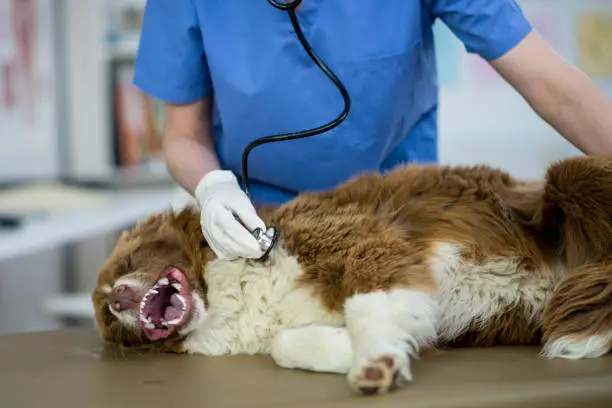
This is where the stethoscope earns its keep. The vet will listen intently to your dog’s chest, and they’re hearing a lot more than just a heartbeat.
- The Lungs: They’re filtering out the normal sounds of air moving in and out and listening for the abnormal ones. Crackling sounds, like cellophane crinkling, can suggest fluid in the lungs—a classic sign of heart trouble. A high-pitched whistle (a wheeze) often means the airways are constricted, perhaps from asthma. The absence of sound in a particular area can be just as telling, potentially indicating a mass or severe blockage.
- The Heart: They’re checking for a strong, regular rhythm. An extra “whooshing” sound, known as a heart murmur, can indicate a leaky valve or other issue. The characteristics of that murmur give the vet important clues about its potential cause and severity. Organizations like the American College of Veterinary Internal Medicine (ACVIM) have detailed classifications that help Vets Diagnose Heavy Breathing in Dogs interpret these findings.
A Look at the Gums and a Careful Feel
The vet will gently lift your dog’s lip. The gums are a window into circulation. Healthy pink is what we want to see. Pale or white gums can signal anemia or shock, while a bluish tint is a serious sign of oxygen deprivation. They’ll also press on the gum to check how quickly the color returns—a delay can mean poor blood flow.
Finally, the vet will use their hands to feel for clues. They might gently press on the throat to see if it triggers a cough, which can be a sign of a tracheal issue. They’ll feel the abdomen for any unusual pain or masses that could be pressing on the diaphragm and making it hard to breathe.
The Diagnostic Toolkit – What the Tests Can Reveal
So, the vet has listened to your story and completed the hands-on exam. They have a few theories about what might be causing the Vets Diagnose Heavy Breathing in Dogs. Now it’s time to move from clues to evidence. This is where diagnostic tests come in. Think of these not as random shots in the dark, but as targeted tools the vet uses to confirm their suspicions and rule out other possibilities.
Vets Diagnose Heavy Breathing in Dogs. The recommendations they make will be based directly on what they learned during the exam. If they heard a loud heart murmur, they’ll be thinking about tests for the heart. If the breathing sounds were noisy and congested, the lungs will be the main focus. It’s a logical, tailored approach.
Blood Work: The Story the Blood Tells
When a vet suggests blood work, they’re essentially asking for a detailed internal report card. It’s one of the most common first steps because it gives a broad overview of your dog’s health. They’re typically looking at two main things Vets Diagnose Heavy Breathing in Dogs:
- The Complete Blood Count (CBC): This test is all about the blood cells themselves. It can reveal if your dog is anemic (has a low red blood cell count), which would mean less oxygen is being carried around the body—a clear reason for Vets Diagnose Heavy Breathing in Dogs. It also checks white blood cells, which can be elevated if there’s an infection or inflammation somewhere in the body.
- The Serum Biochemistry Panel: This part looks at the liquid portion of the blood and assesses organ function. It checks the kidneys, liver, and electrolytes. It can also point to conditions like Cushing’s disease, which is known to cause excessive panting. The results can tell the vet if the breathing problem is a primary lung/heart issue or a symptom of a broader metabolic illness.
In short, blood work helps answer the question: “Is the problem in the breathing system itself, or is it a sign that another organ is struggling?”
X-rays: A Window into the Chest
If blood work gives a chemical report, then a chest X-ray (or radiograph) provides a literal picture of what’s going on inside. This is often the most revealing test for breathing issues. It’s like giving the vet a superpower to see through the skin and bones right into the chest cavity.
What are they looking for on that black-and-white image?
- The Heart: Is it enlarged? Does it have a strange shape? An oversized heart can be a clear indicator of heart disease, which is a very common cause of coughing and labored breathing in older dogs.
- The Lungs: This is key. The vet will scrutinize the lung tissue. Instead of being clear and black, do parts of the lung look hazy or white? This “pattern” can suggest different problems. A fluffy white appearance might mean there’s fluid building up (a condition called pulmonary edema, often from heart failure). A more solid, patchy white area could indicate pneumonia. They’ll also look for any unusual masses or nodules.
- The Airways: The X-ray can show the trachea (windpipe) and larger bronchi. Is the trachea collapsed? Is there something obstructing the airway?
A chest X-ray can often provide a definitive diagnosis or, at the very least, point the investigation in an unmistakable direction. For many owners, seeing the X-ray themselves makes the invisible problem suddenly very real and understandable.
The Echocardiogram: A Live-Action View of the Heart
Sometimes, an X-ray shows an enlarged heart, but it can’t show why it’s enlarged or how well it’s working. That’s where an echocardiogram comes in. Think of it as an ultrasound for the heart—the same technology used to look at human babies in the womb.
This test is incredible because it shows the heart in real-time, beating and pumping. A specialist (a veterinary cardiologist) or a skilled general practitioner will use a probe to get a moving image. This allows them to see:
- The Heart’s Structure: They can measure the thickness of the heart walls and the size of the chambers with precision.
- The Valves: They can watch the valves open and close, checking for leaks (which cause murmurs) or deformities.
- The Pumping Action: They can actually measure how efficiently the heart is pumping blood out to the body.
An echocardiogram is the gold standard for diagnosing specific heart conditions like mitral valve disease or cardiomyopathy. It moves from “the heart looks big” to “the left atrium is severely enlarged because the mitral valve is leaking, which is causing pressure to build up and fluid to leak into the lungs.” That level of detail is what allows for targeted treatment.
When More Detail is Needed: Advanced Tools
For most cases, the combination of history, exam, blood work, and X-rays (with or without an echo) provides the answer. But sometimes, the mystery is deeper, and the vet needs even more advanced tools.
- Bronchoscopy: This involves passing a tiny, flexible camera down into the airways. It’s used if the vet suspects a foreign object is stuck, there’s a growth, or for taking fluid samples directly from deep in the lungs.
- CT Scan: A CT scan is like a super-powered X-ray that takes hundreds of cross-sectional images to create a 3D model of the chest. It provides exquisite detail of the lungs and is invaluable for planning surgery or diagnosing complex diseases.

Piecing the Puzzle Together & Moving Forward
By this point, the vet’s desk might be covered with printouts: blood work results, X-ray films, and perhaps a report from a cardiologist. Individually, these are just pieces of data. But to a trained veterinarian, they are the final pieces of a puzzle. Now comes the most important part: synthesizing all this information to arrive at a definitive diagnosis and a clear path forward.
This is where the initial clues you provided, the findings from the physical exam, and the hard evidence from the diagnostics all converge. Let’s look at a few common scenarios to see how this synthesis works in real life.
The Senior Dog with a Nighttime Cough
Imagine a 10-year-old Cavalier King Charles Spaniel named Buddy. You brought him in because he’s been coughing more at night and seems to get winded on short walks.
- Your Story: You tell the vet the coughing sounds like he’s trying to clear his throat and it’s worse when he’s lying down. He also pants a lot at night.
- The Exam: The vet listens to Buddy’s chest and hears a distinct heart murmur, loudest on the left side. His resting breathing rate is a little high.
- The Tests: The blood work might show mild changes, but the chest X-ray is the star here. It reveals a noticeably enlarged heart and a characteristic hazy pattern in the lungs—the tell-tale sign of fluid buildup (pulmonary edema).
The Diagnosis: The vet puts it all together. The breed is prone to heart disease. The murmur points to a leaky valve. The X-ray confirms the heart is enlarged and fluid has leaked into the lungs, which explains the coughing and labored breathing, especially when lying down (which increases pressure on the heart). The diagnosis is Congestive Heart Failure (CHF).
This isn’t a guess; it’s a conclusion supported by every step of the diagnostic process. Now, treatment can begin with medications to help the heart work more efficiently and remove the excess fluid, giving Buddy immediate relief.
The Noisy, Overweight Bulldog
Now, consider a 5-year-old Bulldog named Bella. She’s always been a bit noisy, but lately, her snorting seems worse, and she seems to panic if she gets too warm.
- Your Story: You describe loud, snorty breathing, especially when she’s excited. She overheats easily and has trouble keeping up on walks.
- The Exam: Just by looking, the vet notes Bella’s flat face and narrowed nostrils. She’s also carrying extra weight. Listening to her chest might be difficult over the loud upper airway noises.
- The Tests: In a case like Bella’s, the physical exam and history are often enough to point strongly to the cause. X-rays might be taken to assess the severity of the condition in her throat and to check her heart, which can be strained by chronic breathing difficulties.
The Diagnosis: The combination of her breed (Brachycephalic), her body condition (overweight), and the classic symptoms leads to a diagnosis of Brachycephalic Obstructive Airway Syndrome (BOAS). This isn’t a single problem but a set of anatomical issues—narrow nostrils, an elongated soft palate, and possibly a narrow trachea—that all work together to make breathing a chore.
The path forward involves weight management, avoiding heat and overexertion, and possibly surgery to correct the anatomical abnormalities and dramatically improve her quality of life.
The Dog with a Sudden Fever and Rapid Breathing
Finally, picture a young, mixed-breed dog named Max who was fine yesterday but today is lethargic, breathing fast, and doesn’t want to eat.
- Your Story: You report a sudden onset of symptoms. Max feels warm to the touch.
- The Exam: The vet finds a high fever and hears crackly sounds in one area of his lungs when listening with a stethoscope.
- The Tests: The blood work shows a dramatically elevated white blood cell count, signaling a significant infection. The chest X-ray reveals a distinct, patchy white area in part of one lung.
The Diagnosis: The fever, the high white blood cell count, and the localized abnormality on the X-ray all point to one conclusion: Pneumonia. The diagnosis allows for immediate and specific treatment with the right antibiotics and supportive care.
Your Partnership in Your Dog’s Health
Walking through this process, from that first moment of concern to a final diagnosis, highlights a crucial point: you are an essential partner in your dog’s healthcare. Your observations provide the initial map. The vet’s expertise guides the journey, using diagnostic tools to navigate to the right destination.
Understanding this process does a few important things. It makes a stressful vet visit feel less intimidating because you know what to expect and why each step is necessary. It helps you see the value in the recommended tests, which can sometimes feel expensive or overwhelming. Most importantly, it empowers you to have a more informed conversation with your veterinarian.
A Final Word
Discovering that your dog has a health condition is never easy. But a clear diagnosis is the first and most critical step toward effective management and treatment. While Vets Diagnose Heavy Breathing in Dogs is frightening, modern veterinary medicine has a robust toolkit to investigate it.
If you’re concerned about your dog’s breathing, don’t hesitate. Trust your instincts. You know your dog better than anyone. By taking them to the vet and being able to clearly describe what you’re seeing, you are giving them the best possible chance at a quick diagnosis and a return to good health. Remember, you and your vet are on the same team, with the same goal: keeping your furry friend happy and healthy for as long as possible.
Frequently Asked Questions
How much does a chest X-ray for a dog cost?
The cost can vary widely depending on your location, the veterinary clinic, and whether sedation is needed. It’s best to call your vet for an estimate, but you can generally expect a range that reflects the specialized equipment and expertise required.
Can blood tests actually show heart problems in dogs?
While blood tests can’t Vets Diagnose Heavy Breathing in Dogs a structural heart issue like a leaky valve, they can provide vital supporting information. A test called NT-pro BNP can indicate if the heart muscle is under stress. Blood work is also crucial for assessing how other organs, like the kidneys, are handling the heart disease, which is important for choosing the right medications.
What if my vet can’t find the cause?
Sometimes, even after initial testing, the picture isn’t perfectly clear. In these cases, your vet will discuss the next steps, which might involve referral to a veterinary internal medicine specialist who has access to more advanced diagnostics like CT scans or bronchoscopy. The process is about following the clues until an answer is found.